
Studying for hours does not always mean learning effectively. When concentration is low, even a simple chapter can feel difficult, distractions become tempting, and information seems to disappear moments after reading it. Learning how to improve concentration while studying can make study sessions more productive without requiring longer hours at the desk.
Better concentration is not about forcing the mind to remain focused every second. It is about creating conditions that make focus easier. A suitable study environment, realistic goals, regular breaks, healthy habits, and simple mindfulness techniques can all support better attention.
Whether a student is preparing for an examination, completing assignments, learning a new skill, or studying for a competitive test, stronger concentration can make the learning process calmer and more effective.
Why Is Concentration Important While Studying?
Concentration helps the mind process, understand, and remember information instead of simply looking at words without absorbing their meaning. When attention is focused, students can understand difficult concepts more clearly, make fewer careless mistakes, and complete study tasks more efficiently.
Poor concentration often creates a frustrating cycle. A student reads the same paragraph several times, checks the phone, thinks about unrelated problems, and eventually feels that studying is taking too long.
Concentration becomes especially important when studying subjects that require deep understanding rather than memorization.
A focused study session can help with:
Understanding difficult concepts
Remembering important information
Completing assignments faster
Reducing careless mistakes
Improving reading comprehension
Preparing more effectively for exams
Building consistent study habits
Reducing unnecessary study stress
The goal is not perfect concentration. Even highly focused people experience wandering thoughts. The goal is to notice distractions and gently return attention to the task.
How Can Students Improve Concentration While Studying?
Students can improve concentration by reducing distractions, studying in shorter focused sessions, setting clear goals, taking planned breaks, maintaining healthy routines, and practicing mindfulness. Concentration improves when the brain has a clear task and the surrounding environment does not constantly compete for attention.
A useful approach is to begin with one specific objective instead of a vague plan.
Instead of thinking, “I need to study science,” a student can decide, “I will understand the first two sections of this chapter and answer five practice questions.”
A specific goal gives the mind a clear direction.
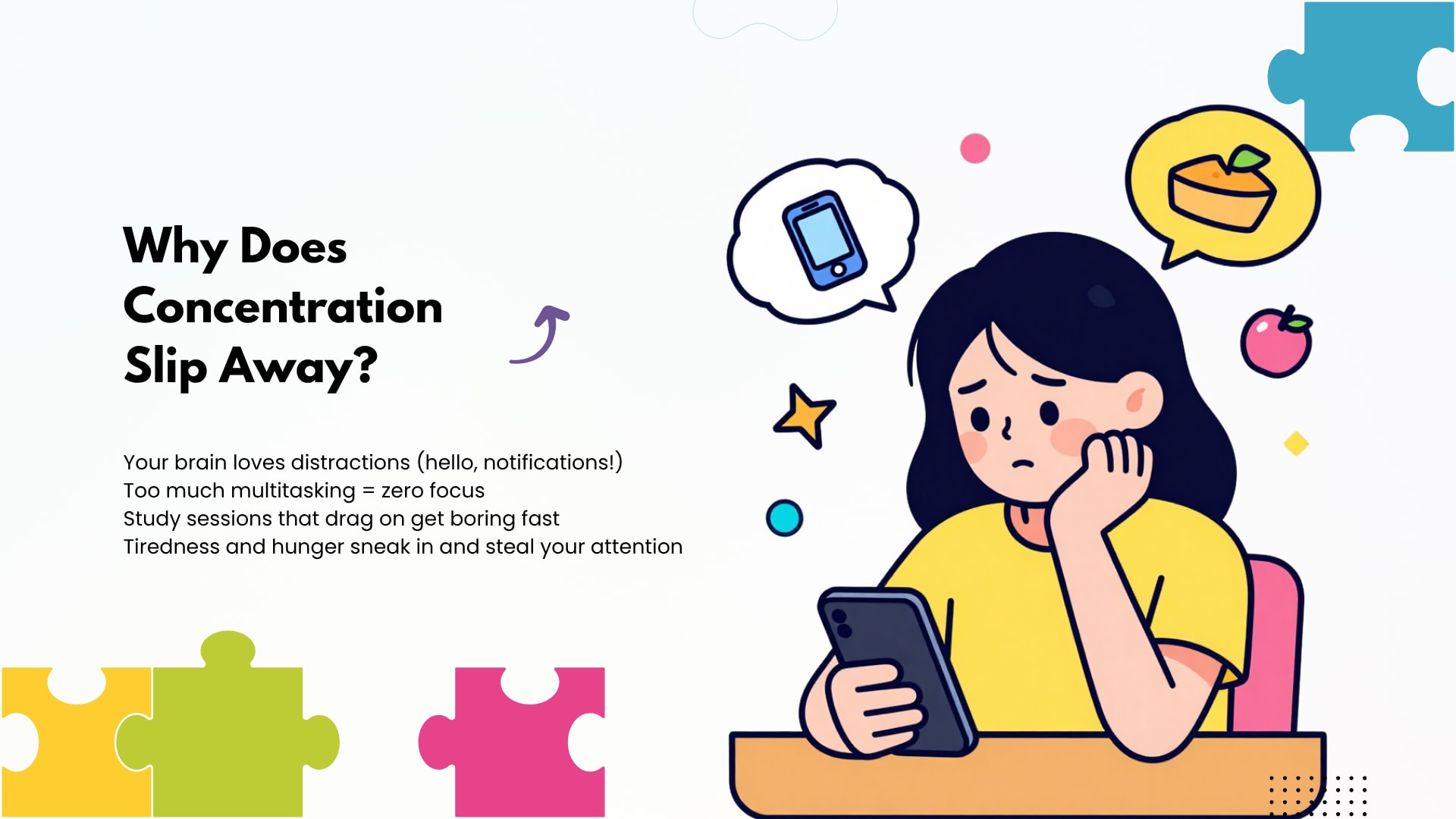
The study environment also matters. A desk covered with unnecessary items, constant phone notifications, television sounds, or frequent conversations can make concentration harder.
Simple changes can make a significant difference.
1. Create a Distraction-Free Study Environment
The study environment can strongly influence concentration. A quiet, organized space reduces the number of external interruptions competing for attention.
A good study area does not have to be expensive or perfect. It simply needs to support focused work.
Before starting, students can:
Keep only necessary books and materials nearby
Put the phone on silent or keep it away from the desk
Turn off unnecessary notifications
Close unrelated browser tabs
Keep water nearby
Use comfortable lighting
Maintain a reasonably tidy workspace
Inform family members or roommates when uninterrupted study time is needed
The phone deserves particular attention because it can become a major source of distraction. Even when a student does not actively use it, notifications and the possibility of checking messages can interrupt attention.
If the phone is not needed for studying, keeping it in another room or inside a bag can make focused sessions easier.
2. Set Small and Clear Study Goals
Large study goals can make the mind feel overwhelmed. “Finish the entire syllabus” sounds much harder than “complete one topic in the next 40 minutes.”
Breaking study work into smaller goals creates a clear starting point.
A student can divide a session into tasks such as:
Read one concept.
Make brief notes.
Review the main points.
Solve related questions.
Check mistakes.
Move to the next topic.
Small goals also provide a sense of progress.
This matters because motivation can increase when students can see that a task is moving forward. Instead of measuring success only by the number of hours spent studying, progress can be measured by topics understood, questions solved, or pages reviewed.
3. Try the Pomodoro Technique
The Pomodoro Technique is a simple time-management method based on focused work periods followed by short breaks. A common version involves studying for 25 minutes and then taking a five-minute break, although students can adjust the timing according to their needs.
For example:
25 minutes of focused study
5-minute break
25 minutes of focused study
5-minute break
25 minutes of focused study
Longer break
The technique can make studying feel less overwhelming because the student does not need to think about concentrating for several hours at once.
Some students may prefer 40–50 minutes of study followed by a 10-minute break. The exact duration is less important than finding a rhythm that supports sustained attention.
During the focused period, the main rule is simple: study only the planned task.
During the break, the mind should be allowed to rest rather than immediately being overloaded with more academic material.
4. Practice Mindfulness Before Studying
Mindfulness can help students become more aware of wandering thoughts and return their attention to the present activity.
A short mindfulness practice before studying does not need to involve complicated techniques.
A student can sit comfortably, close the eyes, and take several slow breaths. Attention can be placed on the movement of breathing. When thoughts appear, there is no need to fight them. The student can simply notice the thought and gently bring attention back to the breath.
After a few minutes, studying can begin.
This practice teaches an important concentration skill: returning attention.
The mind may wander during studying. That does not mean the study session has failed. Each time attention returns to the book, question, or lecture, the student is practicing focus.
5. Avoid Multitasking While Studying
Multitasking may feel productive, but switching repeatedly between tasks can make concentration more difficult.
For example, a student may try to:
Watch a lecture
Reply to messages
Check social media
Listen to music
Take notes
Search unrelated information
at the same time.
The result can be shallow attention across several activities instead of deep attention on one.
Single-tasking is usually a better approach for difficult academic work. One study task should receive attention before moving to another.
If an unrelated thought appears, it can be written on a small piece of paper and addressed later.
This simple technique prevents the thought from repeatedly interrupting the study session.

6. Take Regular Breaks
Taking breaks is not a sign of laziness. The brain needs periods of rest, especially during demanding mental work.
Long study sessions without breaks can lead to mental fatigue. When concentration begins to decline, reading another page may not provide much value.
A short break can involve:
Walking around
Stretching
Drinking water
Looking away from the screen
Taking several slow breaths
Getting some fresh air
Breaks should ideally remain controlled. A five-minute break can easily become thirty minutes if it turns into scrolling through social media or watching videos.
A timer can help keep breaks within the planned duration.
7. Get Enough Sleep
Sleep plays an important role in attention, learning, and memory. A tired student may find it difficult to stay focused even when the material is important.
Late-night studying can sometimes feel productive because more hours are spent at the desk. However, sacrificing regular sleep can make the following day's concentration harder.
Students can support better study performance by maintaining a consistent sleep routine and allowing enough time for rest.
When the mind feels unusually tired, taking a proper break or getting sufficient sleep may be more useful than forcing another hour of ineffective studying.
8. Stay Hydrated and Eat Balanced Meals
Basic physical needs can influence how comfortable and alert a student feels during study sessions.
Keeping water nearby can prevent unnecessary interruptions, while balanced meals can provide steady energy throughout the day.
Students should avoid turning studying into a cycle of skipping meals and relying entirely on highly sugary snacks or excessive caffeine.
A simple routine can include:
Drinking water regularly
Eating balanced meals
Including nutritious snacks when needed
Avoiding excessive caffeine
Avoiding very heavy meals immediately before demanding study sessions
The purpose is not to follow a complicated diet. It is simply to support the body while the brain is doing demanding work.
9. Use Active Learning Instead of Only Reading
Passive reading can make it easy for the mind to wander. Active learning requires the student to interact with the material.
Instead of reading a chapter repeatedly, students can:
Ask questions about the topic
Explain concepts in their own words
Create short summaries
Solve practice questions
Use flashcards
Teach the concept to someone else
Draw simple diagrams
Recall information without looking at the notes
For example, after reading a section about photosynthesis, a student can close the book and explain the process from memory.
This requires concentration and reveals which parts have not yet been understood.
Active learning can therefore make study time more meaningful.
10. Use the Right Study Method for the Subject
Not every subject should be studied in exactly the same way.
Mathematics usually requires problem-solving practice. Languages may require reading, writing, listening, and speaking. Science can benefit from diagrams, explanations, recall, and practice questions. History may require connecting events, dates, causes, and consequences.
Choosing an appropriate method can make concentration easier because the student is actively doing something rather than simply staring at notes.
A useful question is:
“What does this subject require the student to do?”
If the answer is solving problems, practice problems should be central. If the answer is remembering concepts, active recall can be useful.
The study method should match the learning goal.
11. Make Studying More Interesting
Concentration becomes harder when the study process feels completely passive or repetitive.
Students can introduce variety without turning studying into entertainment.
For example, they can alternate between:
Reading
Note-making
Practice questions
Flashcards
Diagrams
Self-testing
Explaining concepts aloud
A difficult topic can also be connected to real-life examples.
When information has meaning, the brain has a stronger reason to pay attention.
12. Manage Stress Before It Takes Over
Stress can make concentration difficult because the mind continues thinking about worries instead of the study task.
A student may sit with an open book while thinking about an upcoming examination, unfinished assignments, family concerns, or fear of failure.
Trying to force those thoughts away may not work.
Instead, students can spend a few minutes writing down what is worrying them and identifying the next practical action.
For example:
Worry: “The examination is very close.”
Next action: “Complete one chapter today and solve ten questions.”
Turning a vague worry into a specific action can make the situation feel more manageable.
Breathing exercises, short walks, mindfulness, and conversations with trusted people can also support emotional balance.
13. Create a Consistent Study Routine
Concentration becomes easier when studying becomes a regular habit.
If a student studies at completely different times every day, it may take longer to get into the right mental state. A consistent routine creates a predictable signal that it is time to focus.
A study routine might include:
Morning: Review difficult concepts
Afternoon: Complete assignments
Evening: Practice questions and revision
The exact schedule depends on the student's responsibilities and natural energy levels.
Consistency matters more than copying someone else's routine.
14. Keep Track of Progress
Tracking progress can help students understand what improves or damages concentration.
A simple study record can include:
Study duration
Subject studied
Number of focused sessions
Topics completed
Major distractions
Energy level
What worked well
After a week, patterns may become visible.
A student might discover that concentration is strongest in the morning or that studying with the phone nearby consistently reduces focus.
This information can be used to improve the routine.
What Should Students Do When Their Mind Keeps Wandering?
When the mind keeps wandering, students should avoid becoming frustrated and instead notice the distraction, identify whether action is needed, and gently return to the study task.
A simple process is:
Notice that attention has wandered.
Identify the distraction.
Write it down if it needs attention later.
Take one slow breath.
Return to the exact point where studying stopped.
The important part is avoiding self-criticism.
Thinking, “I cannot concentrate at all,” creates another distraction. A more useful response is, “The mind wandered, and attention can return now.”
Concentration is a skill that improves through repeated practice.
How Can Students Concentrate When Studying on a Phone or Computer?
Students who need digital devices for studying can improve concentration by using full-screen study tools, disabling unnecessary notifications, closing unrelated applications, and creating clear boundaries between study and entertainment.
A device can be both a powerful learning tool and a major distraction.
Useful habits include:
Turn off social media notifications
Use website blockers when necessary
Keep only study-related tabs open
Avoid checking messages during focused sessions
Download required material before beginning
Use headphones when appropriate
Keep entertainment apps closed
The goal is not to avoid technology.
It is to make technology serve the study session rather than interrupt it.
How Long Should a Student Study Before Taking a Break?
There is no single ideal study duration for everyone. Many students benefit from focused periods of around 25–50 minutes followed by a short break, but concentration levels, age, subject difficulty, and individual preferences can influence the best schedule.
A student should pay attention to signs of mental fatigue.
If attention is dropping sharply, repeatedly reading the same sentence, or making unusually simple mistakes, a short break may be useful.
The quality of focused study matters more than simply accumulating hours.
Two highly focused hours can be more productive than five distracted hours.
Building Better Concentration One Session at a Time
Improving concentration while studying does not require extraordinary discipline. It usually begins with small changes that reduce distractions and give the mind a clear purpose.
A student can start with five simple habits:
Choose one specific study goal.
Keep the phone away during focused sessions.
Study in manageable time blocks.
Take short, planned breaks.
Practice returning attention whenever the mind wanders.
Over time, these habits can become part of a natural study routine.
Concentration is not something that has to be perfect before effective studying can begin. It develops through practice. Each focused session provides another opportunity to strengthen attention, understand the material, and build confidence.https://www.jioskill.com/
The most effective study routine is not necessarily the longest one. It is the routine that allows the student to give genuine attention to the material, rest when necessary, and return consistently the next day.
When concentration, healthy habits, active learning, and realistic planning work together, studying can become less stressful and considerably more productive.
JioSkill Team
Content Creator
Content creator at JioSkill