How AI Is Changing Education and Digital Marketing
Artificial intelligence is changing how people learn, teach, create content, communicate with audiences, and grow businesses. The connection between AI in education and digital marketing is becoming especially important because both fields depend on information, personalization, creativity, and timely communication. AI can help a teacher prepare learning material, help a student understand a difficult concept, help an education company create useful content, and help a marketing team distribute that content to the right audience.
The change is not simply about replacing existing tasks with automation. The bigger shift is how people organize knowledge and turn it into useful experiences. In education, AI can support personalized learning, lesson planning, assessment, research, and administrative work. In marketing, it can support audience research, content creation, campaign planning, social media management, and content distribution.
At the same time, AI is not automatically accurate, ethical, or effective. Human judgment remains necessary. UNESCO's current guidance emphasizes human-centered, inclusive, and ethical approaches to artificial intelligence in education, while its student framework focuses on understanding, applying, and creating with AI responsibly.
Understanding AI in education and digital marketing therefore requires looking at both sides of the opportunity: what artificial intelligence can improve and where human expertise must remain in control.
How is AI changing education and digital marketing?
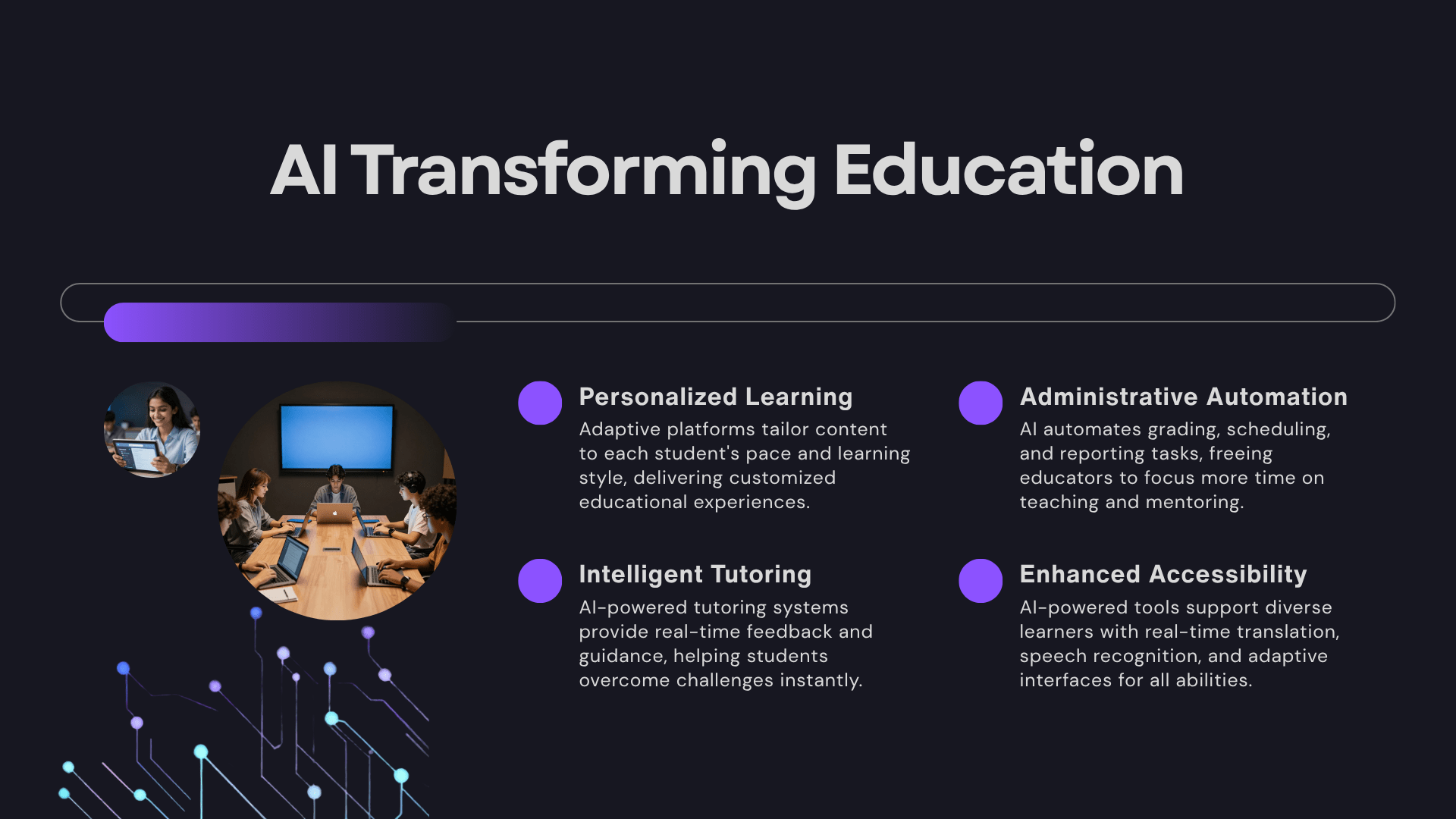
AI is changing education by supporting personalized learning, lesson preparation, assessment, research, and administrative work, while digital marketing is using similar technology for audience research, content creation, social media, campaign planning, and communication. Together, these applications create a connected workflow in which knowledge can be created, adapted, distributed, and measured more efficiently.
The relationship becomes clearer when an educational organization launches a new course.
A teacher or subject expert may first use AI to organize lesson ideas and identify common learner questions. A content team can then turn those ideas into an article, email, infographic, video script, or social media post. Digital marketing tools can help organize the content calendar and prepare variations for different platforms. Analytics can then show which topics attract attention and which require improvement.
The same basic process applies beyond education.
A business selling professional training, online courses, tutoring services, educational software, or learning resources can use AI throughout the content lifecycle. Instead of treating education and marketing as completely separate activities, organizations can connect learning needs with audience communication.
What does AI mean in education?
Artificial intelligence in education refers to computer systems that can perform tasks associated with human intelligence, such as recognizing patterns, generating content, analyzing information, adapting responses, and supporting decisions.
AI-powered education does not necessarily mean replacing teachers with machines. In practical use, it can mean giving educators additional tools for planning, personalization, feedback, research, and routine administration.
The U.S. Department of Education's Institute of Education Sciences identifies several broad applications of AI in education, including instruction and tutoring, personalized learning, assessment, predictive and learning analytics, and administrative tasks. It also emphasizes that AI should support human work rather than simply substitute for people.
That distinction matters.
A teacher understands classroom context, student emotions, learning difficulties, social relationships, and individual circumstances in ways that a general-purpose AI system may not. AI can assist with preparation and information processing, but meaningful education still depends on human relationships and judgment.
What does AI mean in digital marketing?
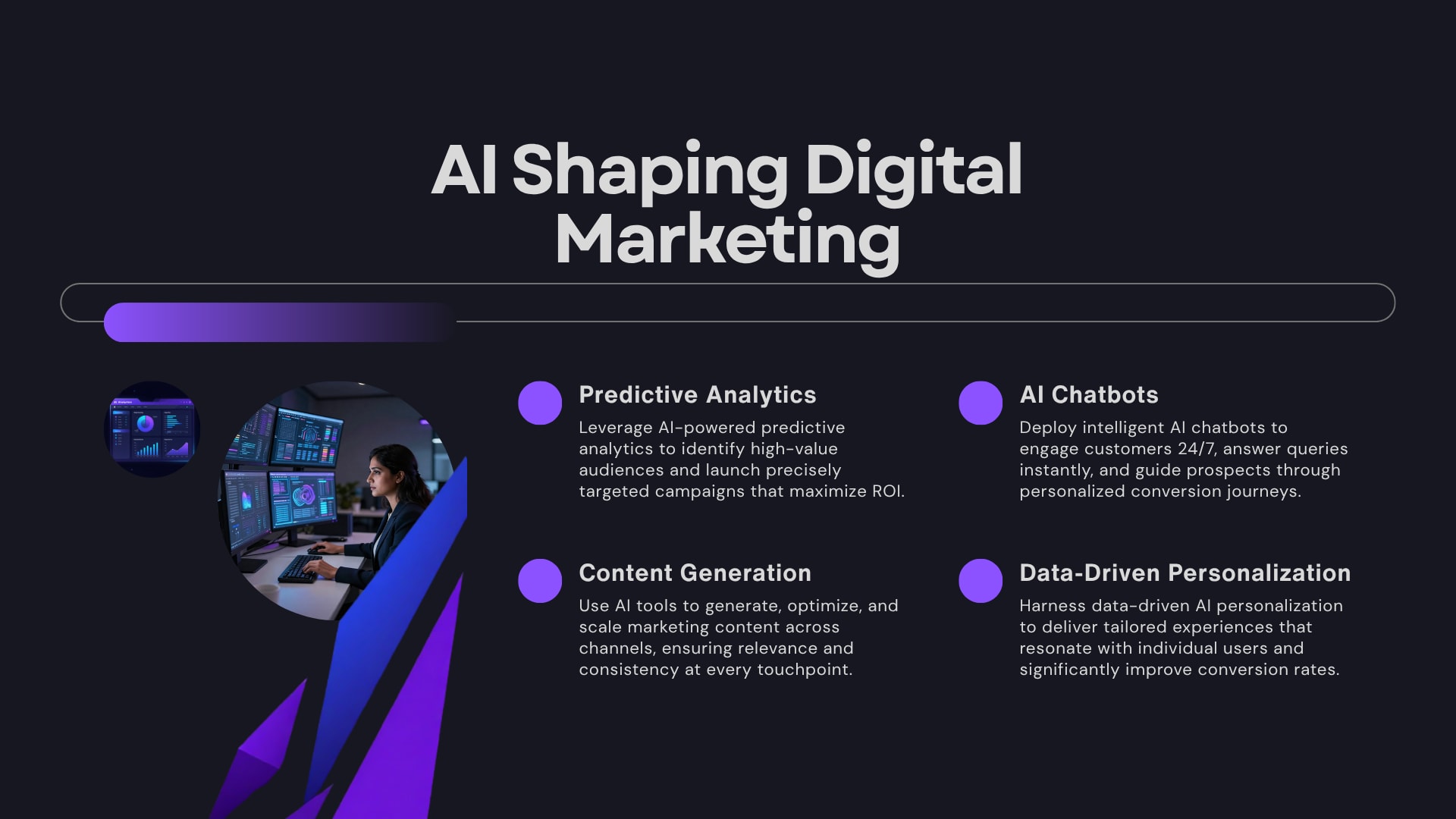
AI for digital marketing refers to using artificial intelligence to support activities such as audience research, content planning, copywriting, image generation, personalization, campaign analysis, social media management, and workflow automation.
A marketer may use AI to turn a broad business goal into content ideas. Another system can help organize those ideas into a calendar. AI-assisted writing can create initial drafts, while a human editor checks accuracy, tone, originality, and brand relevance.
The strongest use of AI-powered marketing is therefore not simply generating more content.
It is creating a better process for deciding what should be created, why it matters, who should see it, and how the results should influence the next piece of content.
Why are education and marketing becoming connected?
Education depends on communication. Marketing also depends on communication.
An educational institution needs to explain programs, answer questions, demonstrate expertise, and build trust. A marketing team needs to understand audiences, communicate benefits, answer objections, and create useful experiences.
This creates a natural connection between education technology and AI-driven digital marketing.
The same research can inform both learning content and marketing content. A list of common student questions can become a lesson plan, FAQ page, blog article, video script, and social media series.
That is one reason AI in education and digital marketing is becoming more than a technology topic. It represents a broader change in how information moves from creation to consumption.
How is AI changing education for students and teachers?
AI is changing education by giving teachers new ways to prepare materials and giving students additional ways to explore information, practice skills, and receive support. Its value is greatest when it strengthens learning rather than removing the thinking, discussion, experimentation, and feedback that make education meaningful.
UNESCO's AI competency framework for teachers identifies competencies across areas such as human-centered thinking, AI ethics, AI foundations and applications, AI pedagogy, and professional learning.
This suggests that effective AI adoption is not simply about giving educators access to tools. Teachers also need to understand how those tools behave and when their output should be questioned.
How can AI help teachers?
Teachers often spend significant time preparing learning resources and handling repetitive tasks. AI can assist with some of this preparation.
For example, an educator may ask an AI system to produce:
Lesson topic ideas
Discussion questions
Practice exercises
Quiz drafts
Reading summaries
Examples for different ability levels
Alternative explanations of difficult concepts
Writing prompts
Classroom activity ideas
First drafts of administrative communications
The teacher remains responsible for checking the material.
A generated worksheet might contain an incorrect fact. A quiz question could be confusing. An explanation might be too advanced for the intended class. AI can speed up preparation, but it does not remove the need for professional review.
How can AI support personalized learning?
Personalized learning is one of the most discussed applications of AI in education.
Students do not all learn at the same speed. One student may understand a concept after one explanation, while another may need several examples and more practice.
AI systems can help adapt explanations, questions, and practice activities based on available information about a learner's progress.
A student studying mathematics, for example, might request another explanation of a problem using simpler language. A language learner may practice conversations and ask for corrections. A student preparing for an examination may use AI to generate practice questions from a topic list.
The technology can provide another layer of support between formal lessons.
However, personalization should not become isolation. Students still benefit from teachers, classmates, discussion, practical activities, and real-world interaction.
Can AI help students become better learners?
AI can support learning when students use it as a thinking partner rather than an answer machine.
A useful approach is to ask AI for:
An explanation of a difficult concept.
A simpler explanation using an everyday example.
Practice questions without answers.
Feedback on a student's attempted solution.
Additional questions that test understanding.
A comparison between two related concepts.
Suggestions for areas that need further study.
This encourages active learning.
By contrast, copying a complete AI-generated answer without understanding it can weaken the learning process. Current evidence remains developing, and the U.S. Institute of Education Sciences notes that research on causal effects of current AI tools on student learning is still limited. Emerging findings suggest that teacher-mediated and AI-augmented tutoring can be promising, while general-purpose AI use may become harmful when it reduces cognitive effort or replaces student thinking.
How can AI support educational institutions?
Schools, universities, coaching organizations, and online learning platforms can use AI in areas beyond classroom instruction.
Possible applications include:
Student support
Frequently asked questions
Course information
Internal knowledge management
Content planning
Administrative communication
Learning analytics
Resource organization
Marketing research
Website content
Social media planning
An institution might discover that prospective students repeatedly ask about admissions, course structure, fees, placement support, or eligibility. Those questions can inform both student-support content and marketing content.
This creates an important connection.
The questions learners ask can become the questions marketers answer.
What are the risks of AI in education?
The biggest risks involve accuracy, privacy, bias, overdependence, unequal access, and inappropriate use.
AI-generated information can be wrong while sounding convincing. Students may also become too dependent on instant answers. Personal information entered into AI systems may create privacy concerns depending on the tool and its data practices.
UNESCO highlights the need for inclusion, equity, human agency, and ethical consideration when AI is introduced into education.
Educational organizations therefore need clear rules covering:
Acceptable AI use
Data protection
Academic integrity
Teacher oversight
Student disclosure
Content verification
Appropriate age and context
Human decision-making
The goal should not be to eliminate AI. It should be to use it responsibly.
How can AI tools make digital marketing more effective?
AI tools can make digital marketing more effective by reducing repetitive work, speeding up research and content production, supporting personalization, and helping teams organize campaigns. Their greatest value comes when they improve the marketing process rather than simply increasing the amount of content published.
Digital marketing has always required several connected activities.
A marketer needs to understand the audience, identify useful topics, create content, publish it, monitor performance, and improve the strategy. AI can assist at many of these stages.
How does AI improve audience research?
Audience research is often the foundation of effective marketing.
AI can help organize large amounts of information and identify recurring themes in customer questions, reviews, comments, search behavior, and existing content.
For example, an education company may discover that its audience repeatedly searches for:
How to choose an online course
Which skills are useful for a particular career
How to prepare for an entrance examination
Whether online learning is effective
How to improve professional skills
These questions can become a content strategy.
Instead of publishing random posts, the marketing team can create content around actual information needs.
How can AI improve content planning?
AI-powered marketing systems can help organize a large collection of content ideas into themes.
A simple content plan might include:
Educational content
Industry insights
Frequently asked questions
Product education
Customer problems
Behind-the-scenes content
Seasonal topics
Case-based explanations
Short-form social content
Long-form articles
AI can help identify connections among these categories and create a repeatable workflow.
One long-form article can potentially become several social posts, a short video script, a carousel concept, an email topic, and a discussion prompt.
The human marketing team should still decide whether each variation is useful and appropriate for the platform.
How is AI changing content creation?
AI content creation can accelerate the first stage of writing and ideation.
A marketer can provide the subject, audience, desired tone, key facts, and business objective. AI can then generate a starting point.
But good content requires more than generation.
Human editors need to verify:
Facts
Brand claims
Examples
Tone
Originality
Relevance
Search intent
Calls to action
Cultural context
This is especially important for education-related content because inaccurate information can affect real decisions.
AI should therefore be treated as a production assistant rather than an unquestioned author.
How can AI improve social media marketing?
AI social media marketing can help businesses manage the repetitive parts of social publishing while leaving strategic decisions to people.
A social media workflow may involve:
Understanding the business and audience.
Identifying relevant content themes.
Building a publishing calendar.
Creating post concepts.
Drafting captions.
Preparing visual concepts.
Reviewing brand consistency.
Scheduling or publishing content.
Monitoring engagement.
Improving future content.
For a small business, this can make a meaningful difference because marketing is often managed alongside sales, customer service, operations, and administration.
Consistency becomes easier when the workflow is organized.
How can AI support visual content?
Social media increasingly depends on visual communication.
AI-assisted tools can help create initial concepts for graphics, campaign visuals, image variations, layouts, and creative directions. This can reduce the time required to move from an idea to a usable draft.
However, visual content still needs human review.
A graphic may technically look polished but fail to match the brand. An AI-generated image may contain strange details. A design may be visually attractive but communicate the wrong message.
Good marketing combines automation with creative judgment.
How can AI support content repurposing?
Content repurposing is one of the most practical uses of AI.
Suppose an education company publishes a detailed article about choosing a professional certification.
That article can inspire:
A LinkedIn post
An Instagram carousel
Short-form video ideas
Frequently asked questions
Email content
A checklist
Discussion questions
A short educational graphic
The core knowledge stays consistent, while the presentation changes according to the platform.
This creates a more efficient relationship between content creation and distribution.
Where can TheViralMarketing fit into AI-powered marketing?
A platform such as TheViralMarketing can be relevant for businesses that want to bring AI assistance into their social media workflow.
TheViralMarketing describes itself as an AI social media marketing platform designed around business context, content planning, content creation, visual content, and social publishing. Its public positioning emphasizes helping businesses maintain a more consistent marketing workflow rather than treating AI as only a caption generator.
For a small educational brand, for example, an AI-assisted workflow could help organize course-related topics, turn them into social content, and maintain a publishing routine. Human marketers can then review the output, make necessary edits, and ensure that the final communication reflects the organization's actual expertise.
The practical benefit is not simply creating content faster. It is reducing the friction between having a marketing idea and turning that idea into an organized publishing process.
What is the difference between traditional and AI-assisted education and marketing?
Traditional workflows generally depend more heavily on manual research, creation, organization, and publishing, while AI-assisted workflows add automated support to repetitive and information-heavy tasks. AI does not eliminate the need for people; instead, it can shift human effort toward strategy, judgment, creativity, relationships, and quality control.
AreaTraditional ApproachAI-Assisted ApproachResearchMostly manual searching and organizationAI can help summarize and organize informationLesson planningTeacher prepares most materials manuallyAI can suggest structures and activity ideasPersonalizationOften requires significant manual effortAI can support adaptive explanations and practiceContent planningIdeas collected manuallyAI can help organize topics and content calendarsContent creationDrafts created manuallyAI can generate starting drafts and variationsSocial mediaPosts prepared and scheduled manuallyAI can support planning, creation, and workflow managementQuality controlHuman reviewHuman review remains essentialDecision-makingMostly human-ledAI can provide analysis, while humans make decisionsCreativityPrimarily humanHuman creativity supported by AI-generated alternativesRisk managementManual policies and checksRequires structured AI governance and human oversight
The important point is that AI-assisted does not mean human-free.
In fact, as AI-generated material becomes easier to produce, human judgment can become more valuable.
How can educational organizations use AI for digital marketing?
Educational organizations can use AI for digital marketing by turning learner questions, educational expertise, and institutional knowledge into useful content that supports discovery, trust, and engagement. AI can assist with research, content planning, writing, social media, and repurposing, while educators and marketers remain responsible for accuracy and strategy.
How can an education brand build an AI content workflow?
A practical workflow can begin with audience questions.
Suppose an online learning company offers courses in digital marketing. Instead of beginning with promotional posts, the marketing team can identify what potential learners want to understand.
Topics could include:
What digital marketing skills are useful for beginners?
How long does it take to learn SEO?
What does a social media manager do?
How can someone build a digital marketing portfolio?
What is the difference between SEO and paid advertising?
AI can help group these questions by search intent.
The marketing team can then create educational articles, short posts, videos, FAQs, and downloadable resources around the same themes.
This approach makes the content more useful because it starts with a real information need.
Can AI improve educational marketing campaigns?
AI can support campaign planning by helping marketers organize audience segments, content themes, messages, and creative variations.
For example, an institution promoting a professional course may communicate differently with:
Recent graduates
Working professionals
Career changers
Business owners
Students exploring new skills
The central course information remains the same, but the message can be adapted to the needs of each audience.
AI can assist with creating these variations.
Human review remains necessary because personalization should not become misleading or manipulative.
How can AI help with SEO content for education?
AI can help marketers identify content structures, related questions, topic clusters, and potential subtopics.
A strong education-focused SEO workflow can include:
Identify the audience.
Understand search intent.
Collect important questions.
Build a logical content structure.
Draft useful explanations.
Add original examples.
Verify factual claims.
Optimize titles and headings.
Add relevant internal and external links.
Review the final article for quality.
The objective should be to answer the searcher's question better, not simply insert keywords repeatedly.
This is especially relevant to AEO and GEO.
Search engines and AI answer systems benefit from clear definitions, direct answers, well-organized information, and context-rich explanations.
What role does human expertise play in AI marketing?
Human expertise remains central because AI does not automatically know the business's real priorities.
A marketing professional understands why one audience matters more than another. A teacher understands whether an explanation is suitable for a particular learner. A brand manager understands which claims can be made safely. A creative professional understands when a generated visual feels generic.
AI can produce possibilities.
People decide which possibilities are worth using.
That difference is likely to remain important even as AI systems become more capable.
What are the main benefits of AI in education and digital marketing?
The main benefits include faster workflows, more personalization, easier content planning, improved productivity, faster idea generation, and greater consistency. In both education and marketing, AI can reduce repetitive work so people have more time for activities that require judgment, communication, creativity, and relationship building.
How does AI save time?
AI can reduce the time spent on repetitive first drafts and organizational work.
A teacher can generate an initial lesson structure rather than starting from an empty document. A marketer can create several headline directions before selecting one. A social media manager can transform a long article into possible short-form content ideas.
Time saved on preparation can then be invested in reviewing and improving the final result.
How does AI support consistency?
Consistency is difficult when content depends entirely on manual effort.
A business may begin a social media campaign with enthusiasm and then stop posting because other responsibilities become more urgent.
AI-assisted workflows can help maintain a content calendar and create repeatable processes.
Consistency, however, should not mean publishing for the sake of publishing.
Useful content remains the priority.
How does AI support experimentation?
Marketing often requires testing different messages, formats, and audiences.
AI can help generate alternatives quickly.
For example, a campaign team might test different educational angles around the same topic:
Problem-focused
Question-focused
Beginner-focused
Data-focused
Story-focused
Human marketers can compare the options and select the versions that best match the audience and brand.
What are the limitations and risks of AI-powered marketing?
AI-powered marketing can produce inaccurate information, generic content, biased outputs, privacy concerns, and excessive automation. Businesses may also become dependent on AI and reduce the human creativity that makes a brand recognizable. Strong governance, editing, fact-checking, and strategic oversight are therefore essential.
Why can AI-generated content be inaccurate?
AI systems generate outputs based on patterns in data and instructions. They do not automatically guarantee that every statement is correct.
A marketing article might include an outdated claim. A social post could mention a feature that a company does not offer. An educational explanation could oversimplify a complex topic.
Every important factual statement should therefore be checked.
Why can AI content feel generic?
When many organizations use similar prompts and tools, their content can begin to sound alike.
Common symptoms include:
Repetitive introductions
Predictable sentence patterns
Empty claims
Excessive enthusiasm
Generic advice
Lack of specific examples
Weak brand personality
The solution is not simply to avoid AI.
The better approach is to add real expertise, original observations, specific examples, audience context, and human editing.
Can AI create privacy concerns?
Yes.
Education and marketing can involve sensitive information. Student records, customer information, contact details, internal documents, and confidential business data should not be entered into AI systems without understanding the applicable privacy and security requirements.
Organizations should establish clear policies about what information can be shared with AI tools.
Can AI replace teachers and marketers?
AI can automate certain tasks performed by teachers and marketers, but that is different from replacing the full role.
Teaching involves relationships, motivation, classroom management, emotional awareness, assessment, and professional responsibility.
Marketing involves strategy, positioning, creativity, relationships, business understanding, negotiation, and decision-making.
AI can reduce the time required for some activities, but the broader roles remain human-centered.
What is the future of AI in education and marketing?
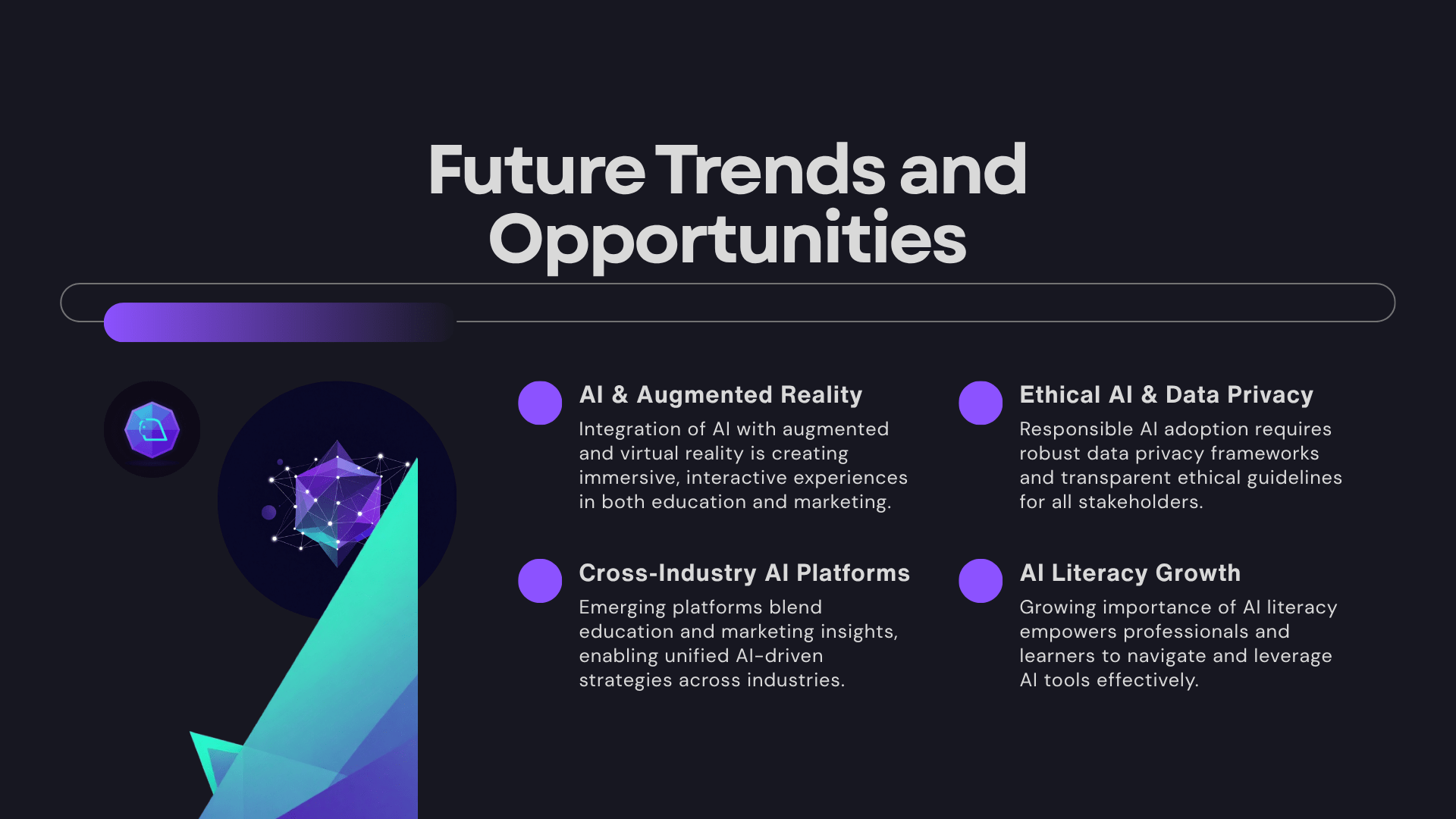
The future of AI in education and marketing is likely to focus on deeper personalization, more connected workflows, AI-assisted research, adaptive learning, automated content operations, and stronger human-AI collaboration. The organizations that benefit most will likely be those that treat AI as part of a responsible system rather than as a shortcut for every task.
UNESCO's work on the future of learning emphasizes both technological and human dimensions, while its competency frameworks encourage students and teachers to develop the knowledge needed to work responsibly with AI.
Several developments are likely to shape the next stage.
Will AI make learning more personalized?
Personalization is likely to become more sophisticated as learning platforms collect better information about progress, preferences, and areas of difficulty.
However, personalization must be balanced with privacy and human interaction.
A highly personalized learning environment is not necessarily a better one if it limits social learning or encourages students to remain isolated from teachers and peers.
Will AI change the role of marketers?
Marketing professionals are likely to spend less time on repetitive production and more time on strategy, quality control, brand development, audience understanding, and creative direction.
Instead of asking whether AI can write a caption, the more valuable question becomes whether a marketer can build a complete system that turns audience insight into useful content and then learns from the response.
Will AI make content creation easier?
Yes, but easier creation may increase the importance of differentiation.
When anyone can generate hundreds of posts, the scarce resource becomes attention.
Useful, original, trustworthy content will matter more than content volume.
Brands will need strong opinions, real expertise, recognizable voices, and better understanding of their audiences.
What skills will educators and marketers need?
Both groups will increasingly benefit from AI literacy.
Important skills include:
Critical thinking
Prompting and instruction
Fact-checking
Data awareness
Ethical decision-making
Content editing
Audience research
Strategic planning
Privacy awareness
Communication
Creative judgment
UNESCO's student competency framework similarly emphasizes human-centered thinking, ethics, AI techniques and applications, and AI system design.
AI literacy is therefore becoming broader than knowing how to operate a particular tool.
How should businesses and educators start using AI responsibly?
Organizations should begin with a clear problem rather than adopting AI simply because it is popular. The strongest starting points are usually repetitive, low-risk tasks where AI can assist humans without controlling important decisions. From there, organizations can test results, establish review procedures, protect sensitive information, and gradually expand successful workflows.
A practical implementation process can look like this:
Step 1: Identify one repetitive problem
Examples include content ideation, lesson preparation, FAQ creation, social media planning, or document summarization.
Step 2: Choose an appropriate AI tool
The tool should match the task rather than forcing every problem into one platform.
Step 3: Define human responsibility
Someone should be responsible for checking the output before it reaches students, customers, or the public.
Step 4: Create quality standards
The organization should decide what acceptable output looks like.
Step 5: Protect sensitive information
Clear rules should determine which information may and may not be entered into AI systems.
Step 6: Measure usefulness
The question should not simply be whether AI generated something.
The better question is whether it improved the actual workflow.
Step 7: Improve the process
AI adoption should be treated as an ongoing process. Tools change, user expectations change, and organizational needs change.
This approach avoids the common mistake of automating a poor process.
Frequently Asked Questions About AI in Education and Digital Marketing
How is AI changing education?
AI is changing education by supporting personalized learning, lesson preparation, tutoring, assessment, research, administrative tasks, and learning analytics. It can give teachers additional support and provide students with new ways to practice and explore concepts. Human supervision remains essential because AI-generated information can be inaccurate or inappropriate.
How does AI help teachers and students?
Teachers can use AI to create lesson ideas, practice activities, quizzes, explanations, and first drafts of educational materials. Students can use AI for guided explanations, practice questions, feedback, brainstorming, and additional examples. The strongest results occur when AI supports learning rather than replacing student thinking or teacher judgment.
How is AI changing digital marketing?
AI is changing digital marketing by assisting with audience research, content planning, copywriting, visual concepts, social media management, personalization, analytics, and content repurposing. It can reduce repetitive work and help marketing teams move faster, but strategy, fact-checking, brand judgment, and creativity still require human involvement.
Can AI improve educational marketing?
Yes. AI can help educational organizations understand common audience questions, plan content, create drafts, adapt messages for different audiences, and maintain social media publishing. Educational marketing can become more useful when AI is used to answer real learner questions rather than simply produce promotional material.
How can businesses use AI for content marketing?
Businesses can use AI to research topics, organize content ideas, generate initial drafts, repurpose long-form content, create social media variations, and analyze performance information. The final content should be reviewed for factual accuracy, originality, brand voice, and usefulness before publication.
How can AI improve social media marketing?
AI can help with content calendars, post ideas, captions, creative concepts, content repurposing, scheduling workflows, and performance analysis. It can be especially useful for small teams that struggle to maintain consistent publishing. Human review is still needed to ensure that posts are accurate, relevant, and aligned with the brand.
What is AI-powered education?
AI-powered education refers to educational experiences that use artificial intelligence to support activities such as personalized learning, tutoring, assessment, content generation, learning analytics, or administrative work. It does not necessarily mean automated teaching. In many cases, AI works alongside educators.
What are AI tools for educators and marketers?
AI tools for educators may support lesson planning, tutoring, practice, assessment, research, and administration. AI tools for marketers can support content creation, audience research, SEO, social media planning, visual production, analytics, and workflow automation. The best tool depends on the specific task and the organization's requirements.
Can AI replace digital marketers?
AI can automate parts of digital marketing, but it does not fully replace the broader role of a marketer. Marketing requires business understanding, positioning, audience relationships, creative judgment, strategic decisions, and responsibility for results. AI is more useful as an assistant within a well-designed marketing system.
Is AI-generated educational content reliable?
AI-generated educational content should be reviewed before use. AI can produce incorrect or incomplete information even when the writing sounds confident. Teachers, subject experts, and editors should verify important facts and make sure the content is appropriate for the intended learners.
What are the biggest concerns about AI in education?
Major concerns include accuracy, privacy, bias, academic integrity, unequal access, overdependence, and the possibility that students may use AI in ways that reduce learning effort. UNESCO recommends human-centered and ethical approaches that protect inclusion, equity, and human agency.
What is the future of AI in education and marketing?
The future is likely to involve closer collaboration between humans and AI. Education may become more personalized, while marketing workflows may become more automated and responsive. At the same time, human creativity, critical thinking, ethics, and judgment will remain important because AI systems need people to determine what should be created, trusted, and acted upon.
Conclusion
AI in education and digital marketing represents a larger shift in how information is created, organized, personalized, and shared. In education, artificial intelligence can support teachers, personalize learning, assist students, and reduce repetitive administrative work. In digital marketing, it can help organizations research audiences, plan content, create drafts, manage social media workflows, and repurpose useful information across channels.
The strongest results do not come from allowing AI to operate without supervision.
They come from combining the speed of AI with the judgment of people.
A teacher can use AI to prepare a lesson but still decide what students actually need. A student can use AI to explore a difficult concept but still do the thinking required to understand it. A marketer can use AI to generate content ideas but still determine whether those ideas are valuable, accurate, and appropriate for the audience.
For organizations working at the intersection of education, content, and marketing, this human-AI partnership can create a more efficient workflow without sacrificing quality.
Platforms such as TheViralMarketing can fit into this transition by helping businesses organize AI-assisted social media and content workflows. Used thoughtfully, such systems can reduce repetitive marketing work and give teams more time to focus on strategy, creativity, relationships, and meaningful audience communication.
The future of AI in education and marketing is therefore not simply about automation.
It is about better collaboration between technology and human expertise.
AI can accelerate the process, but people still determine the purpose, quality, accuracy, and ethical direction of the work.
JioSkill Team
Content Creator
Content creator at JioSkill