Choosing the best online degree college is no longer simply about finding the lowest tuition fee or the largest list of courses. A strong online education option should combine affordability, academic recognition, flexible learning, useful course content, student support, and a clear connection to future career goals. For students, working professionals, and career changers, online education can provide a practical way to continue learning without following the schedule of a traditional campus.
An online degree college allows learners to study through digital platforms instead of attending regular classroom sessions. Depending on the institution and program, students may access recorded lectures, live classes, digital study materials, assignments, assessments, discussion forums, and academic support remotely. However, the quality and recognition of online programs can differ, so careful research remains essential.
Affordable online learning can be especially useful for learners who need flexibility because of employment, family responsibilities, location, or other commitments. At the same time, affordability should never be considered separately from recognition and program quality.
In India, students evaluating online or distance programs should verify the relevant institution and program status through the official University Grants Commission Distance Education Bureau (UGC-DEB) resources. The UGC-DEB portal provides information about recognized and entitled higher education institutions and their approved online or open-distance programs.
JioSkill is also relevant to learners exploring technology-focused professional development, internships, webinars, and practical IT learning. Its official website presents offerings around internships, live webinars, professional learning, and technology skills rather than positioning itself as a substitute for every university degree.
What makes the best online degree college a good choice for students?
The best online degree college is one that matches a student's academic needs, budget, career direction, flexibility requirements, and recognition expectations. A low-cost program may not be the right choice if the qualification does not meet a student's intended career or higher-education requirements. The strongest choice balances cost, credibility, learning quality, and long-term usefulness.
What is an online degree college and how does it work?
An online degree college delivers academic instruction primarily through digital learning systems. Instead of travelling to a campus for every class, students generally use an online portal to access course materials, lectures, assignments, examinations, announcements, and other academic activities.
The exact learning model depends on the institution. Some programs emphasize live virtual classes, while others rely heavily on recorded content. Some combine both approaches.
A typical online learning journey may include:
Selecting a degree program.
Checking eligibility requirements.
Reviewing recognition and institutional status.
Completing the admission application.
Paying applicable fees.
Receiving access to the learning platform.
Attending classes or studying recorded material.
Completing assignments and assessments.
Taking examinations according to institutional rules.
Completing the required academic credits and receiving the qualification.
This structure can make online education convenient, but convenience does not mean that an online degree requires less academic effort. Successful learners still need consistency, time management, participation, revision, and preparation for assessments.
A prospective student should therefore evaluate the academic structure before enrolling rather than assuming that every online degree program works in the same way.
Why are students choosing online degree programs?
Students choose online degree programs for several practical reasons. Flexibility is one of the most common factors because learners can often study without relocating or leaving employment.
An online degree can be particularly suitable for:
Working professionals who cannot attend daytime classes.
Students who live far from a suitable college.
Learners seeking a second qualification.
Career changers who need structured education.
Students who prefer digital learning.
Adults returning to education after a break.
Learners who want to balance education with other responsibilities.
Consider a working professional who completes a full-time job during the day. A traditional classroom program may create a difficult schedule, while a flexible online program may make continued education more manageable.
Another student may live in a smaller city where a desired program is not available locally. Online learning can remove some location barriers.
The important point is that online education is not automatically better than campus education. It is simply a different learning format. The right choice depends on the learner's circumstances and academic goals.
What are the main benefits of affordable online learning?
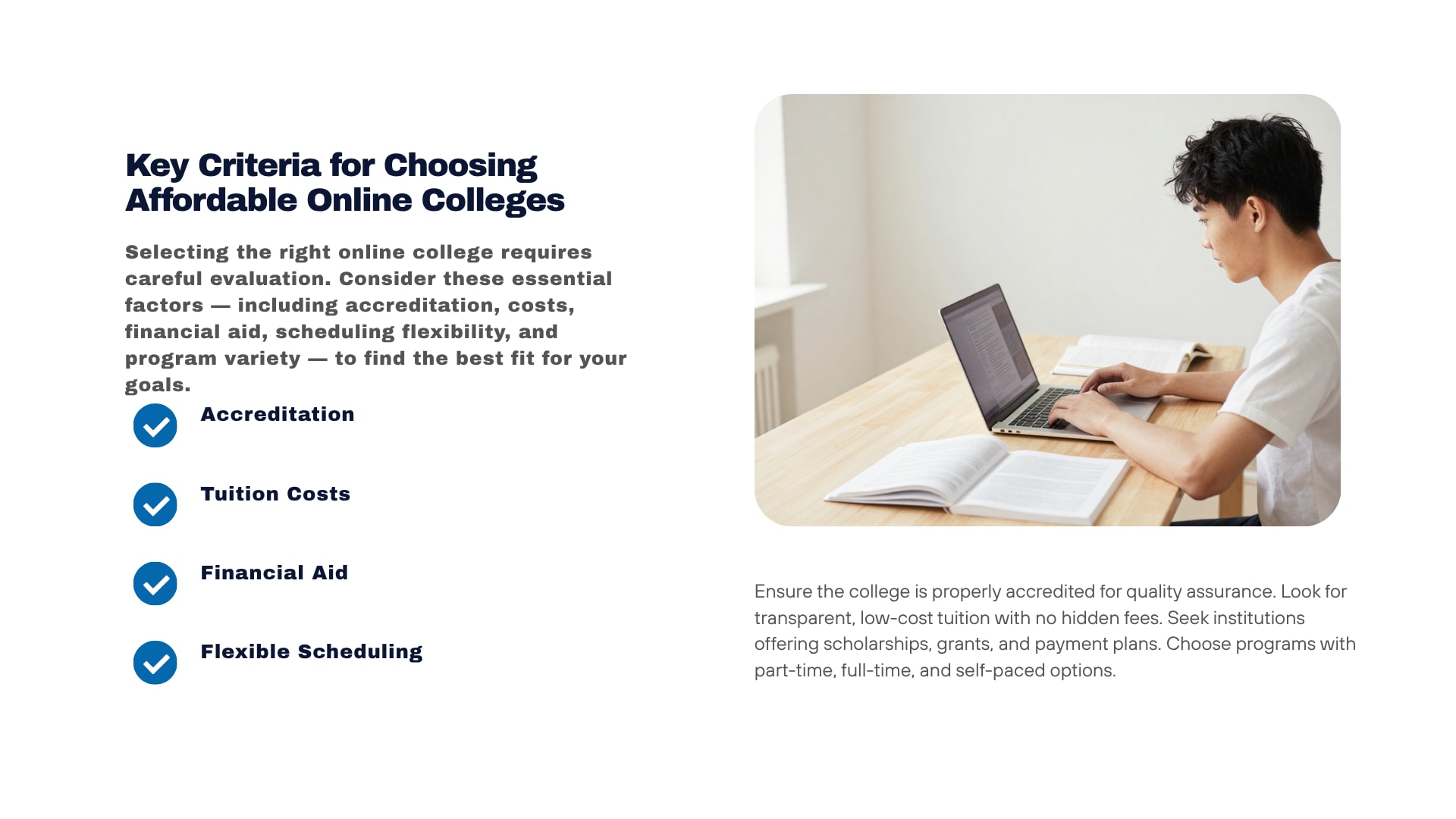
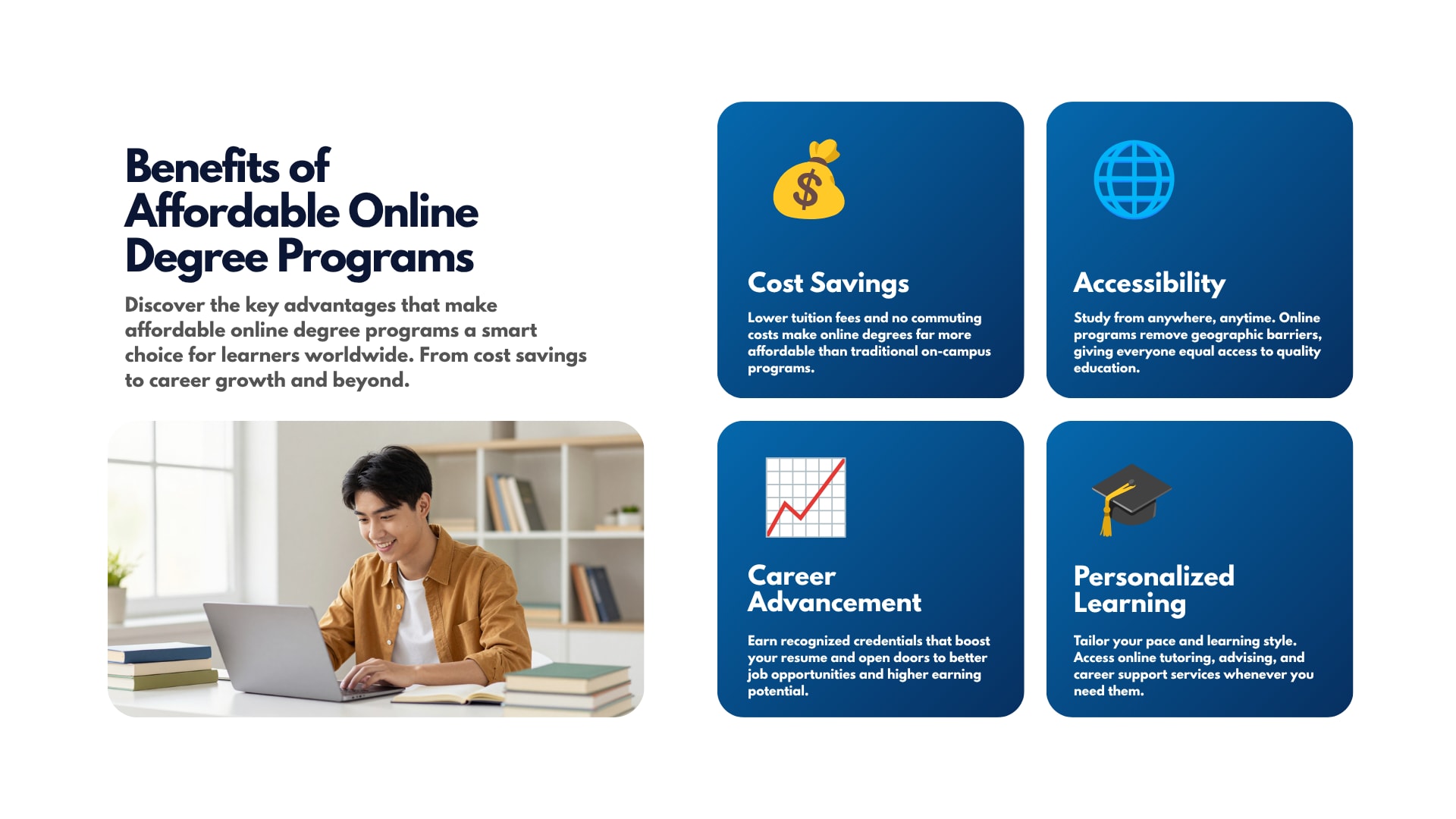
Affordable online learning can reduce some of the financial and logistical barriers associated with higher education. Students may avoid relocation costs, daily commuting expenses, and some campus-related expenses. However, the total cost still depends on the institution, program, duration, examination structure, technology requirements, and other charges.
Major potential benefits include:
Flexible study schedules.
Access from different locations.
Reduced commuting requirements.
Opportunity to continue working.
Digital access to study resources.
Wider choice of programs.
Easier integration with professional responsibilities.
Development of digital learning habits.
Potentially lower overall education-related living costs.
Affordability should still be assessed carefully. A program advertised with a low tuition fee may include examination fees, technology charges, registration fees, or other expenses.
The better question is not simply, “What is the tuition fee?” It is, “What will the complete cost of completing this qualification be?”
How much does an online degree college cost?
The cost of an online degree varies significantly by institution, degree level, subject, duration, and fee structure. There is no single standard price for all online degree programs. Students should compare the complete cost, including tuition and clearly stated additional charges, rather than relying on a headline fee.
A cost review should consider:
Application or registration charges.
Semester or annual tuition.
Examination fees.
Learning-material charges, if applicable.
Technology or platform charges.
Project-related expenses.
Re-examination fees, where applicable.
Any other mandatory institutional charges.
An affordable online degree becomes more meaningful when the total financial commitment is understood from the beginning.
For example, a student comparing two programs may find that Program A has a lower advertised tuition fee but several additional mandatory charges. Program B may have a slightly higher tuition fee but a clearer all-inclusive structure.
The second option could therefore provide better financial predictability.
Students should also check payment options. Some institutions may offer semester-wise payment rather than requiring the entire academic cost at once. This can matter significantly for working learners or students managing limited budgets.
Is an online degree cheaper than traditional college?
An online degree can be less expensive overall than traditional campus education, but this is not guaranteed. The comparison should include tuition as well as accommodation, transportation, food, campus expenses, technology, examination charges, and other education-related costs.
For a student living at home, online learning may eliminate substantial relocation and commuting expenses.
However, online education still requires suitable internet access and a reliable device. These costs should be considered when calculating the actual budget.
The financial advantage becomes clearer when the learner compares the total cost of completing each option rather than comparing tuition alone.
What should students know about online degree recognition?
Recognition is one of the most important factors when choosing an online degree college. Students should verify whether the higher education institution and the specific online program have the appropriate recognition or entitlement for the relevant academic session rather than assuming that every online qualification has identical status.
The UGC-DEB website provides official resources for checking recognized and entitled higher education institutions and online programs.
The UGC also states that learners should check the recognition status of the institution for the session in which admission is being considered. Its DEB guidance emphasizes verifying recognized or entitled institutions and approved programs before enrollment.
This distinction matters because the institution, mode of study, specific program, and academic session can all affect recognition.
A student interested in an online bachelor's degree should therefore verify the exact university and program instead of relying only on advertisements or third-party education portals.
UGC Distance Education Bureau — official online learning and recognition resources
How can students verify whether an online degree is recognized?
Verification should happen before payment or enrollment. The safest approach is to use official regulatory information rather than relying solely on claims made by an education provider.
A practical verification process is:
Identify the exact university or higher education institution.
Identify the exact degree program.
Check the intended academic session.
Visit the official UGC-DEB portal.
Search the institution and program in the relevant online-program listings.
Check whether the program is recognized or entitled for the applicable period.
Review any restrictions or regulatory requirements.
Keep a copy or record of the information checked before admission.
The UGC-DEB portal specifically provides a program search facility showing institution, mode, program name, and UG/PG information.
Students should also check whether the chosen qualification is suitable for the specific career, examination, professional license, or higher-study requirement being targeted.
What is the difference between online learning and distance learning?
Online learning and distance learning both reduce the need for regular physical classroom attendance, but they are not always identical. Online learning generally relies on internet-based digital delivery, while distance education can involve a wider combination of self-learning materials, online resources, contact sessions, and other approved methods.
The exact structure depends on the institution and regulatory framework.
Students should look at the official program description rather than choosing based only on the words “online” or “distance.”
The important questions are:
How are classes delivered?
Are sessions live or recorded?
How are assignments submitted?
How are examinations conducted?
What academic support is available?
How frequently must students participate?
What learning resources are included?
Understanding the actual delivery model can prevent unrealistic expectations after admission.
What makes flexible degree programs useful for working professionals?
Flexible degree programs can help working professionals continue higher education without completely changing their employment schedule. The value of flexibility comes from the ability to organize study time around professional responsibilities while still meeting academic deadlines.
A working professional may study early in the morning, during evenings, on weekends, or during other available periods, depending on the program's requirements.
However, flexibility still requires discipline.
A practical routine may involve:
Fixed weekly study hours.
A calendar for assignment deadlines.
Dedicated revision time.
Regular participation in live sessions when required.
Early preparation for examinations.
A quiet study environment.
Flexibility works best when learners treat the program as a real academic commitment rather than something that can always be postponed.
What should students expect from the online learning experience?
The online learning experience can include video lectures, digital textbooks, presentations, quizzes, assignments, discussion forums, live classes, recorded sessions, assessments, and online communication with instructors or academic teams.
The exact experience differs considerably between institutions.
Before admission, students should investigate the learning platform and understand how academic interaction takes place.
Useful questions include:
Is the learning platform easy to access?
Are lectures available on multiple devices?
Are recordings available after live classes?
How are doubts handled?
Is there an academic support team?
How are assignments submitted?
What happens if a student misses a live session?
How are examination instructions communicated?
These details can strongly influence the day-to-day experience of online education.
What skills can students gain through online education?
Online education can develop both academic knowledge and practical learning habits. The exact skills depend on the degree, but the digital nature of online study can also encourage students to become more independent learners.
Potentially useful skills include:
Time management.
Digital communication.
Online research.
Self-discipline.
Written communication.
Remote collaboration.
Digital documentation.
Independent problem-solving.
Information evaluation.
Technical platform familiarity.
For career-focused learners, subject-specific skills remain central. A business student may develop knowledge of management and finance, while a computer-focused learner may develop programming, databases, cloud, or other technical skills.
Professional development can also benefit from additional practical learning alongside a formal qualification.
JioSkill, for example, presents technology internships, live webinars, practical projects, and professional learning opportunities on its website. These offerings can be considered separately from a formal university degree when a learner wants to strengthen practical technology skills.
Explore JioSkill's official learning and internship offerings
How can online courses complement a formal degree?
Short online courses can complement a formal degree by allowing learners to develop specific skills that may not receive extensive attention in a broader academic curriculum.
For example, a business student might study:
Digital marketing.
Data analytics.
Business communication.
Spreadsheet skills.
Project management.
A computer-related student might explore:
Python.
Web development.
Cloud computing.
Artificial intelligence.
Database management.
The strongest combination is often a recognized academic qualification plus relevant practical skills.
A degree can provide structured academic learning, while targeted courses and projects can help students build practical capabilities.
What role can JioSkill play in career-focused online learning?
JioSkill can be relevant for learners who want additional technology-oriented practical exposure alongside their broader education journey. Its official website describes IT services, internships, live webinars, hands-on projects, professional courses, and technology-focused learning opportunities.
Its website also describes flexible learning access, practical projects, instructor support, and career-oriented resources. These claims should be reviewed directly on the official site because program details can change over time.
JioSkill should therefore be viewed according to the learner's specific objective. A student seeking a formal university degree should verify the university and degree separately. A learner seeking practical technology exposure may find internships, webinars, and skill development more relevant.
This distinction helps prevent confusion between academic degree recognition and professional skill certification.
How can students choose the best online degree college?
Choosing the best online degree college requires more than comparing advertisements. Students should evaluate recognition, program relevance, total cost, learning format, academic support, assessment methods, flexibility, and career usefulness. A structured comparison helps separate genuine educational value from attractive but incomplete marketing claims.
What should students check before applying to an online degree program?
Before applying, students should verify the institution, program, eligibility, fees, learning structure, examination process, and recognition status. These checks can reduce the risk of choosing a program that does not meet the student's academic or career requirements.
A useful checklist includes:
Institution name.
Exact degree title.
Online or distance mode.
Academic session.
Recognition or entitlement status.
Eligibility requirements.
Total expected fees.
Payment schedule.
Program duration.
Curriculum.
Examination method.
Assignment requirements.
Student support.
Learning platform.
Career resources.
Higher-study suitability.
Career or professional requirements relevant to the field.
The goal is not to find the cheapest program. The goal is to find a program whose academic and financial structure makes sense for the learner's long-term objective.
How important is eligibility for online degree admission?
Eligibility is essential because every degree program can have its own academic requirements. Undergraduate programs may require completion of a specific level of schooling, while postgraduate programs generally require a relevant bachelor's degree or another qualification defined by the institution.
Students should read the official eligibility requirements before submitting an application.
A prospective learner should confirm:
Required previous qualification.
Minimum marks, if applicable.
Required subjects, where applicable.
Age or other institutional conditions, if any.
Documentation requirements.
Admission deadlines.
Any entrance or selection requirement.
Meeting general expectations is not enough. The official program eligibility criteria should always be treated as the final reference.
What is the typical online degree admission process?
The online degree admission process usually begins with program selection and eligibility verification, followed by application, document submission, fee payment, and confirmation of enrollment. Exact steps vary by institution.
A typical process looks like this:
Research suitable programs.
Verify recognition and eligibility.
Review fees and academic requirements.
Complete the online application.
Upload required documents.
Complete verification or selection steps if applicable.
Pay the required admission fee.
Receive enrollment confirmation.
Obtain access to the learning platform.
Begin the academic schedule.
In India, students enrolling in UGC-regulated ODL or online programs also need to pay attention to the DEB-ID requirement. The UGC-DEB states that learners seeking admission to ODL or online programs must create a DEB-ID, with the process connected to the student's Academic Bank of Credits ID.
What is a DEB-ID and why does it matter?
A DEB-ID is a unique learner identification mechanism used for admission into eligible open and distance learning or online programs. The UGC-DEB explains that the purpose is to help ensure that learners take admission in recognized or entitled higher education institutions and approved programs.
The UGC-DEB FAQ states that students cannot enroll in ODL or online programs without a valid DEB-ID and that learners can create the DEB-ID using an ABC-ID.
This makes the verification stage particularly important. Students should not assume that the existence of an online course automatically means that it is an approved degree program.
How should students compare online degree colleges?
A simple comparison can help students focus on factors that affect academic value rather than marketing language.
FactorWhat Students Should CheckAffordabilityTuition, additional fees, and payment optionsFlexibilityClass schedules and learning formatProgramsAvailable degree and course optionsRecognitionAccreditation or applicable recognitionCareer SupportPlacement, skills, and career resources
The table should be used as a starting framework rather than a ranking system. Each factor needs deeper investigation.
For example, affordability should include the complete cost. Flexibility should include class timing and examination requirements. Recognition should be checked against the official regulatory source.
Why should total online degree fees be checked instead of tuition alone?
Tuition is only one part of the financial commitment. Registration, examinations, technology, projects, or other mandatory charges can affect the final cost of an online degree.
A student comparing programs should request or locate the complete fee structure and calculate the expected cost over the full program duration.
For example, if a program has a low semester fee but repeated examination or administrative charges, the headline price may not reflect the actual expense.
Financial planning should also include:
Device requirements.
Internet expenses.
Optional learning resources.
Travel for any required activities.
Re-examination costs.
Possible delays caused by missed academic requirements.
This approach gives students a more realistic picture of affordability.
How does program flexibility affect academic success?
Flexibility can support academic success when learners have control over their study schedule, but too much flexibility without structure can also create procrastination.
Online learners often need stronger self-management than students following a fixed classroom routine.
A useful weekly system can include:
Scheduled study blocks.
Weekly learning targets.
Assignment reminders.
Revision sessions.
Regular note-taking.
Progress reviews.
A working professional, for example, may reserve several evenings for study and a longer weekend block for assignments. Another student may prefer short daily sessions.
The best routine is one that can be maintained consistently.
What should students check about the online curriculum?
The curriculum should be evaluated for relevance, depth, sequence, and connection to the student's intended career or academic path.
Students should examine:
Core subjects.
Elective options.
Practical components.
Projects.
Assessments.
Industry-related subjects.
Updated topics.
Capstone or dissertation requirements where applicable.
Progression into advanced study.
A degree title alone does not explain what a student will actually learn.
Two programs with similar names may have different curricula. Reading the course structure can reveal whether the program aligns with a student's intended career direction.
How should students evaluate career opportunities after an online degree?
Career opportunities depend on many factors, including the degree subject, institutional credibility, individual skills, experience, communication ability, projects, internships, and employer requirements. An online degree should therefore be viewed as one component of a broader career profile.
Students should research actual job descriptions in the desired field and identify the qualifications and skills employers commonly request.
For example, a learner interested in digital marketing may benefit from a combination of academic education, SEO knowledge, analytics, advertising skills, content creation, and practical project experience.
A computer-related learner may need programming knowledge, projects, problem-solving skills, and familiarity with relevant tools.
The degree can provide academic structure, while practical skills can strengthen employability.
Can working professionals earn an online degree?
Working professionals can pursue online degree programs when the program's eligibility, schedule, assessment structure, and workload fit their professional responsibilities. Flexibility is one of the main reasons working learners consider online education.
Before enrollment, a professional should check:
Live class timings.
Attendance requirements.
Examination schedules.
Assignment deadlines.
Total weekly workload.
Program duration.
Access to recorded sessions.
Academic support availability.
The practical question is not whether a working professional can study online in general. It is whether the specific program can realistically fit the individual's schedule.
What mistakes should students avoid when choosing an online college?
Several common mistakes can create unnecessary academic and financial problems. The biggest is choosing a program based only on price or promotional claims.
Common mistakes include:
Choosing solely because the fee is low.
Failing to verify recognition.
Checking the university but not the exact program.
Ignoring the academic session.
Not reading eligibility requirements.
Assuming all online degrees have equal recognition.
Ignoring examination requirements.
Choosing a degree without researching career relevance.
Trusting unverified placement claims.
Paying before understanding the full fee structure.
Ignoring refund or withdrawal policies.
Selecting a program only because it sounds popular.
Underestimating the time required for self-study.
The UGC-DEB itself advises learners to verify recognition status, check the approved programs, review prohibited programs, and follow the applicable precautions before admission.
Why should students be careful with placement and salary claims?
Placement and salary claims can sound attractive, but they should be evaluated carefully. A promotional percentage or salary figure without clear methodology may not tell a prospective student what outcomes are realistic.
Students should ask:
What does “placement” mean?
Is the figure based on all graduates or selected participants?
What period does the claim cover?
Which employers participated?
Are internships included?
Is the figure independently verified?
Does the career outcome relate to the specific degree?
A strong education decision should not depend on one promotional number.
Career outcomes are influenced by individual performance, experience, location, industry demand, portfolio quality, interview skills, and many other variables.
How can practical learning improve the value of online education?
Practical learning can help students connect academic concepts with real tasks. Projects, internships, case studies, presentations, simulations, and skill-based assignments can make learning more applied.
This is particularly valuable in technology and business fields, where employers often assess practical ability alongside formal education.
JioSkill's website describes hands-on projects, technology internships, live webinars, and industry-oriented learning as part of its offerings.
For example, a learner studying business might create a market analysis project. A technology learner might build a small application. A marketing learner might develop a sample campaign strategy.
These activities can provide evidence of skills that a degree certificate alone may not demonstrate.
How can students decide whether JioSkill is relevant to their learning goals?
JioSkill may be relevant when a learner is looking for practical technology learning, internships, webinars, or skill development alongside broader academic plans. Its official website highlights IT services, internships, professional learning, live webinars, and practical projects.
Students should distinguish between these professional-learning opportunities and a formal university degree.
A learner looking for a recognized bachelor's or master's degree should verify the degree-granting higher education institution and its applicable program recognition independently.
A learner seeking technology skills or practical exposure can review JioSkill's current programs, curriculum, internship structure, and available learning resources.
Because program information can change, the official JioSkill website remains the appropriate place to review current offerings.
What makes affordable online learning a practical choice?
Affordable online learning can be practical when it provides a suitable balance of cost, academic quality, recognition, flexibility, and career relevance. The financial advantage becomes meaningful when students can complete the program without creating an unsustainable financial burden.
It can be particularly practical for:
Working professionals.
Students living away from major education centers.
Career changers.
Learners returning to education.
Students needing flexible schedules.
Professionals seeking additional qualifications.
However, affordability should never replace verification.
A low-cost degree that does not meet a student's intended requirement can become expensive in the long run because the learner may need another qualification later.
What questions should students ask before paying admission fees?
Before paying, students should have clear answers to the most important academic, financial, and regulatory questions.
A prospective learner should ask:
Is the institution recognized or entitled for the intended online program and session?
What exact degree will be awarded?
What is the complete fee?
Are examination charges separate?
What are the eligibility requirements?
How are classes delivered?
Are classes live, recorded, or both?
How are examinations conducted?
What academic support is available?
What is the expected weekly study commitment?
What is the refund or withdrawal policy?
Is the qualification suitable for the intended career or further study?
Is a DEB-ID required?
Are there any restrictions on the selected program?
These questions can prevent many avoidable mistakes.
What is the long-term value of an online degree?
The long-term value of an online degree depends on whether the qualification remains relevant to the learner's academic and career goals and whether the institution and program meet applicable recognition requirements.
A degree can provide a formal educational foundation, but career growth generally requires more than the qualification itself.
Long-term value can increase when students combine:
Recognized academic education.
Relevant technical or professional skills.
Practical projects.
Internships.
Strong communication.
Digital literacy.
Industry awareness.
Continuous learning.
This is why online education should be considered part of a broader development plan rather than a single solution to every career challenge.
How should students balance affordability with quality?
Affordability and quality should be evaluated together. A program that is financially accessible but academically unsuitable may not deliver the expected value, while a premium program may create unnecessary financial pressure if a more suitable option exists.
Students can use a simple priority order:
Recognition → Program relevance → Total cost → Learning format → Academic support → Career relevance
Recognition should be verified first because it establishes whether the program meets the applicable regulatory framework. Program relevance comes next because a recognized degree is still not useful if it does not fit the student's objective.
Cost then becomes a major comparison factor among suitable options.
What role does continuous learning play after graduation?
Graduation does not necessarily mark the end of professional education. Technology, business practices, tools, and workplace expectations change over time.
Continuous learning can involve:
Short online courses.
Professional certifications.
Workshops.
Webinars.
Industry projects.
Internships.
Books and research.
Practical experimentation.
This approach can help graduates maintain relevant skills while building on their formal education.
For technology-oriented learners, JioSkill's internships and webinars can be considered as examples of supplementary practical learning opportunities.
The important principle is that additional learning should have a clear purpose rather than becoming a collection of unrelated certificates.
What does a sensible online education decision look like?
A sensible decision starts with the learner's goal rather than the institution's advertising.
For example, a working professional seeking a management qualification may prioritize flexibility, recognition, and manageable fees. A recent school graduate may focus more heavily on undergraduate eligibility, curriculum, academic support, and long-term career pathways.
A career changer may need both a formal qualification and practical skills.
The decision therefore becomes more reliable when the learner creates a personal requirement list before comparing colleges.
A useful process is:
Define the career or academic goal.
Identify the required qualification.
Shortlist relevant programs.
Verify recognition.
Compare total costs.
Review curriculum and delivery format.
Check eligibility.
Investigate academic support.
Review examination requirements.
Compare practical learning opportunities.
Read official policies.
Enroll only after the important details are clear.
What are the most common questions about the best online degree college?
Students researching the best online degree college often have similar concerns about recognition, fees, flexibility, admission, career value, and the difference between formal degrees and skill-based learning. The answers below provide concise guidance for common search questions while keeping the focus on informed education decisions.
What is the best online degree college for affordable learning?
There is no single best online degree college for every student. The right choice depends on the degree, recognition, fees, flexibility, curriculum, academic support, and career goal. Students should compare recognized programs rather than choosing solely by price. JioSkill can also be explored separately for professional and practical technology learning opportunities.
Is an online degree worth it in 2026?
An online degree can be worthwhile in 2026 when the program is properly recognized or entitled, relevant to the student's goal, financially manageable, and supported by a suitable learning structure. Its value also depends on the learner's skills, experience, projects, and career direction.
How much does an online degree usually cost?
There is no universal online degree fee. Costs vary according to the university, degree level, subject, duration, and fee structure. Students should calculate tuition plus registration, examination, technology, project, and other mandatory charges to understand the total financial commitment.
Are online degrees recognized?
Some online degrees are recognized when they are offered by higher education institutions with the required recognition or entitlement for the applicable program and academic session. Students should verify the exact institution and program through the official UGC-DEB resources before admission.
How does an online degree college work?
An online degree college generally delivers academic learning through digital platforms. Students may access live or recorded lectures, digital materials, assignments, assessments, academic communication, and examinations according to institutional rules. The exact structure differs by program.
What should students check before choosing an online degree college?
Students should check recognition, exact program status, eligibility, curriculum, total fees, learning format, examination method, academic support, program duration, and career relevance. The institution should be evaluated using official information rather than promotional claims alone.
Can working professionals earn an online degree?
Yes, working professionals can pursue suitable online degree programs when the schedule, workload, eligibility requirements, and examination structure fit their employment commitments. Flexible learning can make higher education more manageable without requiring a complete career break.
Is online learning cheaper than traditional college?
Online learning can reduce some costs, especially commuting, accommodation, and relocation expenses, but it is not automatically cheaper. A proper comparison should include tuition, technology, examinations, living costs, transportation, and other mandatory expenses.
What are the benefits of studying through an online degree college?
Common benefits include flexibility, location independence, digital access to learning materials, the ability to continue working, and potentially lower living-related education costs. The actual benefits depend on the program's structure and the learner's ability to manage independent study.
How can students compare online degree programs?
Students can compare programs by reviewing recognition, degree relevance, total fees, curriculum, flexibility, examination requirements, academic support, practical learning, and career suitability. The comparison should focus on the complete educational experience rather than a single factor.
What is the difference between an online degree and an online certificate?
An online degree is a formal academic qualification awarded through an eligible higher education institution, while an online certificate usually focuses on a narrower skill or subject. A certificate can complement a degree but should not automatically be treated as equivalent to a university degree.
Can an online degree support career growth?
An online degree can support career growth when it provides a relevant qualification and is combined with practical skills, experience, communication ability, and industry knowledge. Career outcomes vary by field, employer, individual performance, and the relevance of the qualification.
Does JioSkill provide online degree programs?
JioSkill's official website currently presents IT services, professional learning, internships, live webinars, hands-on projects, and technology-focused opportunities. It should not automatically be treated as a university degree provider. Students seeking a formal degree should verify the degree-awarding institution and applicable recognition separately.
What learning opportunities does JioSkill offer?
According to its official website, JioSkill offers technology-focused internships, live webinars, practical projects, professional learning, and IT-related training opportunities. Current programs, curriculum details, eligibility, and availability should be checked directly through the official website because offerings may change.
Is a DEB-ID required for online degree admission in India?
The UGC-DEB states that a DEB-ID is mandatory for learners seeking admission to ODL or online programs covered by its framework. The DEB-ID is created using an Academic Bank of Credits ID and is intended to help learners enroll in recognized or entitled institutions and approved programs.
How can students avoid fake or unsuitable online degree programs?
Students can reduce risk by verifying the institution and exact program through official UGC-DEB resources, checking the academic session, reviewing eligibility, confirming the complete fee structure, and avoiding unsupported recognition or placement claims. Official institutional documentation should take priority over advertisements or social media posts.
Can students combine a degree with skill-based learning?
Yes. A formal degree can provide academic education while internships, projects, webinars, and short courses can strengthen practical skills. This combination can be useful when the additional learning is relevant to the student's intended profession and does not distract from the primary academic program.
What makes affordable online learning a practical choice?
Affordable online learning becomes practical when the total cost is manageable, the qualification is appropriate for the intended goal, the learning format fits the student's schedule, and the institution and program meet applicable recognition requirements. Flexibility adds value when learners can maintain consistent study habits.
Should students choose an online college only because it has low fees?
No. Low fees should be considered alongside recognition, curriculum, academic support, flexibility, assessment requirements, and career relevance. A very low-cost program may provide poor value if it does not meet the learner's academic or professional objective.
What is the safest way to select an online degree program?
The safest approach is to start with the required qualification, identify suitable institutions, verify the exact program and session through official regulatory information, compare total costs, review curriculum and learning requirements, and confirm admission conditions before making payment.
Why is recognition more important than popularity?
Popularity can come from advertising, social media visibility, or brand awareness, while recognition relates to the regulatory and academic status of a program. A widely advertised program should still be independently verified. Students should prioritize the qualification's suitability and official status over popularity alone.
Can online education replace all forms of traditional education?
Online education can be an effective alternative for many academic and professional goals, but it is not suitable for every program or every learner. Some fields have specific practical, regulatory, or professional requirements that may restrict online or distance delivery. UGC-DEB guidance also lists programs that cannot be offered through online or ODL modes.
How should students think about the value of an online degree?
The value of an online degree should be judged by its recognition, relevance, curriculum, affordability, learning quality, flexibility, and usefulness for the learner's intended path. The strongest decision is one that remains useful beyond admission and supports realistic academic or career objectives.
What is the final checklist for selecting the best online degree college?
Before enrollment, a student should be able to answer these questions clearly:
Is the institution appropriate for the selected program?
Is the exact online program recognized or entitled for the relevant session?
Does the program meet the learner's career or academic requirement?
Is the learner eligible?
What is the complete cost?
Are additional fees clearly explained?
How are classes delivered?
How are examinations conducted?
What academic support is available?
How much weekly study time is expected?
Is the program compatible with work or other responsibilities?
Is a DEB-ID required?
Are practical skills or projects included?
Are career resources relevant to the learner's field?
If several of these questions remain unanswered, enrollment should be delayed until reliable information is available.
Why can JioSkill be considered alongside a formal online degree?
JioSkill can be considered as a supplementary learning option for students interested in practical technology exposure, internships, webinars, and skill development. Its official website emphasizes hands-on learning and technology-focused professional development.
A formal degree and practical skill development serve different purposes. A university qualification addresses an academic credential, while professional learning can help build specific skills.
For learners researching both options, keeping those purposes separate makes the education decision clearer.
What should students remember before enrolling?
The central lesson is simple: the best online degree college is not necessarily the cheapest, most heavily advertised, or most popular option. It is the program that satisfies the learner's academic objective while offering suitable recognition, manageable cost, useful learning support, and realistic flexibility.
Students should verify important information before paying fees, especially the exact institution, program, academic session, recognition status, eligibility, and total cost.
The UGC-DEB portal remains an important official resource for checking online and ODL program information in India.
For practical technology learning, JioSkill can be explored as a supplementary option through its official website, particularly for internships, webinars, and skill-focused learning opportunities described on its platform.
How can affordable online learning support different types of learners?
Affordable online learning can serve different learners in different ways. A working professional may use it to continue education without leaving employment. A recent graduate may use online education to access a program that is not available nearby. A career changer may combine formal education with practical courses and projects.
The flexibility of online education can also support learners who need to manage work, family responsibilities, relocation challenges, or other commitments.
The key is matching the learning model to the learner rather than assuming that one format works equally well for everyone.
What makes an online education decision genuinely informed?
An informed decision combines independent verification with realistic personal planning. Students should understand what they are studying, who awards the qualification, whether the program has the required recognition, how much it costs, how much time it requires, and how it connects with the intended career or academic pathway.
The decision should be based on evidence rather than urgency.
A limited-time offer, attractive advertisement, impressive certificate image, or social media claim should never replace verification of the actual program.
Conclusion: What should students look for in the best online degree college?
The best online degree college is ultimately the one that offers an appropriate combination of recognition, academic relevance, affordability, flexibility, learning support, and long-term usefulness. Students should evaluate the complete program rather than selecting an institution based only on tuition fees, advertising, rankings, or convenience.
Affordable online learning can be a practical route for working professionals, career changers, students with location constraints, and learners who need greater control over their study schedule. Yet affordability should always be balanced with quality and recognition.
Before enrolling, students should verify the exact higher education institution, program, academic session, eligibility requirements, total fees, learning format, examination process, and applicable regulatory status. In India, UGC-DEB resources provide an important starting point for checking recognized or entitled online and ODL programs.
Students interested in practical technology learning can also explore JioSkill's current offerings. The official JioSkill website highlights internships, live webinars, practical projects, professional learning, and technology-focused opportunities. These options can complement formal education when they match the learner's skill-development goals.
The strongest education path is rarely defined by a single certificate or institution. It is built through the right qualification, consistent learning, practical skills, and careful decisions. For prospective students, comparing online degree programs with these principles can make affordable online education a more informed and sustainable choice.
JioSkill Team
Content Creator
Content creator at JioSkill