

Top 10 Cloud Computing Trends Transforming Businesses in 2025 , Think back to just five years ago. Most companies were still debating whether to move their data off physical servers. Fast forward to today, and we’re dealing with something far more complex. Businesses aren’t just managing technology anymore—they’re racing to keep up with it.
Here’s what I’ve noticed working with companies across different industries: their tech needs are exploding while their ability to manage everything efficiently is struggling to catch up. Old systems can’t handle modern customer expectations. Security breaches are becoming more sophisticated. Costs keep climbing. And everyone’s under pressure to innovate faster than their competition.
The traditional IT playbook? It’s gathering dust. What we’re seeing now with cloud computing trends 2025 goes way beyond incremental updates. These are game-changing shifts that completely transform how businesses run their operations, stay competitive, and scale. Let me walk you through the ten trends making the biggest impact right now , Top 10 Cloud Computing Trends.
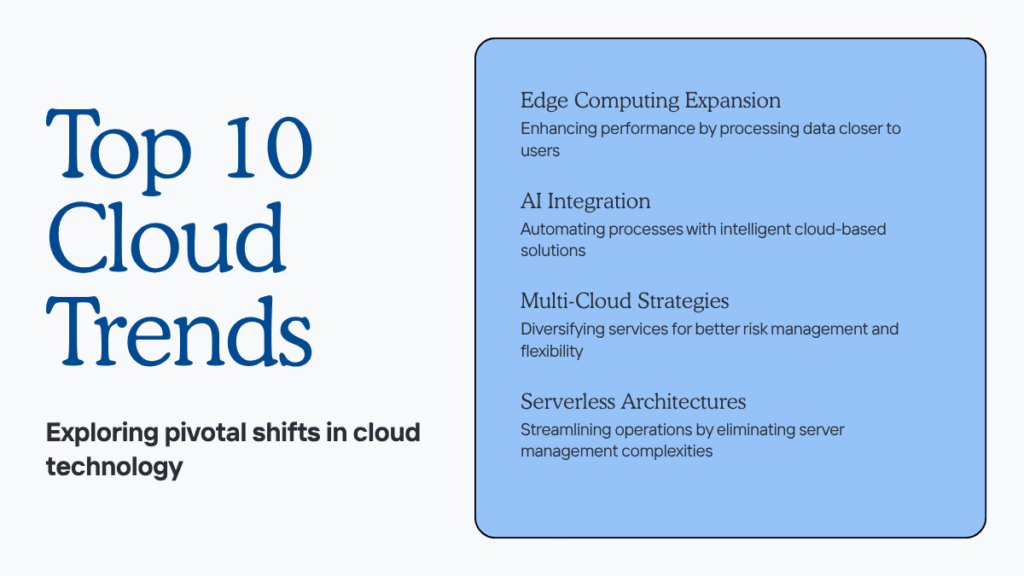
1. AI in Cloud Computing: Adding Brains to the System
AI in cloud computing isn’t some experimental tech anymore. It’s already baked into how companies run their infrastructure, and honestly, the results are pretty impressive.
Real Companies, Real Results
Look at Spotify. They’ve got AI working in their cloud that watches how millions of people listen to music—all happening live. The system knows when to add more servers before rush hour even hits. It predicts traffic spikes before they happen. Sounds like sci-fi, right? Except it’s running right now.
When people talk about the cloud computing future, AI sits right at the center. Here’s what it’s handling Top 10 Cloud Computing Trends:
- Figuring out resource needs automatically instead of guessing
- Catching problems before they break anything
- Spreading workloads intelligently across servers
- Spotting threats the moment they appear
Banks like JPMorgan Chase lean on AI-powered cloud platforms to speed up transactions while hunting for fraud at the same time. Every transaction teaches the system something new. It gets better every single day.
2. Multi-Cloud Strategy: Spreading Your Bets
You know that old saying about eggs and baskets? Turns out it applies to cloud computing too. Companies with any sense aren’t locking themselves into one provider anymore. They’re going with a multi-cloud strategy, and there’s some solid reasoning behind it.
Why It Makes Business Sense (Top 10 Cloud Computing Trends Transforming Businesses in 2025)
Take Netflix. They run on AWS, Google Cloud, and their own setup. If one provider hits a snag, traffic just flows to another. That’s how they keep their service up 99.99% of the time, even when major outages take down other companies.
Going with a multi-cloud strategy means you get:
- Real leverage when negotiating with vendors (competition works in your favor)
- Freedom to pick the perfect tool for each job
- Lower risk because you’re not dependent on one company
- Easier compliance when you need data in specific locations
Dropbox started out completely on AWS. Later, they built their own infrastructure for popular files but kept AWS for everything else. That move alone saved them around $75 million in two years.
3. Hybrid Cloud Computing: Getting the Best of Both
Not every piece of data should live in the public cloud. Sometimes you need things on-premises—maybe for legal reasons, security concerns, or just better performance. That’s exactly where hybrid cloud computing comes in handy Top 10 Cloud Computing Trends.
How It Works in Practice
General Electric uses hybrid cloud for their industrial IoT stuff. Their sensitive manufacturing data? That stays locked down in private data centers. But analytics and reporting? Those run on public cloud where they can scale easily. They get control where it matters and flexibility everywhere else.
Hybrid cloud computing really shines for:
- Healthcare companies dealing with patient information
- Financial firms facing strict regulations
- Manufacturers stuck with older systems
- Government agencies working with classified data
The beauty of it? Security where you absolutely need it, flexibility for everything else.
4. Edge Computing: Bringing Processing Closer to Home
Sending data halfway across the world to a data center and waiting for an answer doesn’t always work. Some applications need responses immediately. Edge computing fixes this by handling data right where it’s created , Top 10 Cloud Computing Trends.
Why Speed Matters
Tesla’s self-driving cars can’t afford to wait for cloud servers. Decisions happen in split seconds. Their cars crunch sensor data right there in the vehicle (that’s the edge) and only send summaries back to headquarters for improvements.
Walmart uses edge computing in stores for:
- Processing payments instantly, even when the internet’s down
- Tracking how customers move through aisles in real time
- Keeping inventory systems running smoothly
- Running security cameras independently
This matters a lot for cloud-native applications that need to function both centrally and at the edges.
5. Serverless Cloud: Only Pay When You’re Actually Using It
Traditional cloud billing charges you for servers sitting idle. Serverless cloud flips that around—you only pay when your code actually does something , Top 10 Cloud Computing Trends.
The Money Side
Coca-Cola’s vending machines run on serverless. Instead of paying for servers running constantly, their code only fires up when someone buys a drink. This cut their infrastructure costs by 65% compared to old-school hosting.
Serverless works great for:
- Apps with traffic that’s all over the map
- Businesses with seasonal ups and downs
- Startups watching every dollar
- Tasks that run occasionally, not constantly
The New York Times uses serverless to turn articles into audio. The system mostly sits there doing nothing, then jumps into action when needed, handling thousands of conversions in minutes when demand spikes.
6. Cloud Security Automation: Defending at Computer Speed
Hackers don’t clock out at 5 PM. By the time a person spots an attack and reacts, damage might already be done. Cloud security automation bridges that gap , Top 10 Cloud Computing Trends.
Defense That Never Sleeps
Capital One (yes, despite their history) now runs automated security watching millions of events every second. Spot something weird—an odd login, unexpected data access—and the system responds instantly. No waiting for someone to notice and react.
Cloud security automation covers:
- Round-the-clock monitoring of every access point
- Immediate response that shuts down attacks as they happen
- Automatic compliance checking to stay within regulations
- Self-repair systems that bounce back from attacks on their own
Companies using these automated tools find and stop breaches 80% faster than those still doing it manually.
7. Sustainable Cloud and Green Computing: Tech’s Environmental Reckoning
Data centers eat up about 2% of the world’s electricity. As more companies go cloud-heavy, that number climbs. The environmental cost is real, and businesses are starting to take it seriously.
Making Cloud Greener
Google hit carbon neutral on their data centers by using AI to run cooling systems smarter and buying renewable energy. Their whole cloud runs on 100% renewables now, and they’re shooting for completely carbon-free by 2030 , Top 10 Cloud Computing Trends.
Sustainable cloud means:
- Running data centers on solar, wind, and other renewables
- Getting more work out of each server to cut waste
- Building in colder places to need less cooling
- Reusing server heat for other purposes
Microsoft’s data center in Finland captures all that server heat and pumps it into nearby buildings. They turned a problem into an asset.
Green cloud computing isn’t just feel-good PR anymore. Customers want to work with eco-conscious companies, and regulations are starting to require carbon reporting.
8. Quantum Cloud Computing: Tomorrow’s Tech, Today
Quantum cloud computing sounds like something from decades in the future, but you can access it right now through IBM Quantum and Amazon Braket. We’re in early days, sure, but things are moving fast.
What’s Happening Now
Boehringer Ingelheim, a pharmaceutical company, uses quantum computing via the cloud to simulate how molecules interact for drug development. Calculations that would take regular computers years? They finish in days or hours.
Financial companies are testing quantum for:
- Optimizing investment portfolios with millions of factors
- Risk analysis that handles incredibly complex market dynamics
- Fraud patterns too subtle for traditional computers
- Encryption that’ll stay secure even when quantum gets mainstream
You don’t need to own a quantum computer. Cloud providers let you access it pay-as-you-go, putting quantum power within reach for companies of any size.
9. Data Sovereignty: Where Your Data Lives Matters
The physical location of your data isn’t just a technical detail anymore. Different countries have different rules about privacy, storage, and who can access what. Data sovereignty means your data follows the laws of wherever it’s physically stored , Top 10 Cloud Computing Trends.
Dealing With Different Rules
When GDPR hit in the EU, American companies had to completely restructure their cloud storage. They couldn’t just keep European customer data on US servers anymore. Salesforce and others now offer regional cloud options that keep data inside specific borders.
Data sovereignty affects:
- Global expansion for growing companies
- Compliance needs across different countries
- Customer confidence, especially in privacy-focused markets
- Government deals that require local storage
SAP built dedicated cloud regions for data requirements in places like Germany and China. This lets them serve worldwide customers while following local rules.
10. Cloud-Native Applications: Built for This Environment
There’s a difference between moving old software to the cloud and building something designed for cloud from scratch. Cloud-native applications squeeze every advantage out of cloud capabilities right from the start.
Architecture That Makes Sense
Airbnb completely rebuilt their platform as cloud-native using microservices. Instead of one giant application, they created hundreds of small, independent pieces that scale on their own. Booking demand jumps in Europe? Only those specific services scale up—not the whole system.
Cloud-native applications usually have:
- Microservices breaking things into bite-sized, manageable chunks
- Container deployment keeping everything consistent
- Auto-scaling that handles demand without human intervention
- Continuous updates allowing rapid improvements and fixes
Traditional apps might take weeks to add features. Cloud-native apps can deploy updates several times daily because their structure supports fast, safe changes.
Capital One moved thousands of applications to cloud-native setups, dropping deployment times from months to minutes while making everything more reliable.
Getting This to Work for You
These cloud computing trends 2025 aren’t abstract concepts. They’re practical tools businesses are using today to fix real headaches. You don’t need all ten at once. Start with whatever addresses your biggest pain points.
If security worries keep you awake, focus on cloud security automation. If costs are out of control, look into serverless cloud or a multi-cloud strategy. Expanding globally? Make data sovereignty a priority.
The winning companies today don’t necessarily have the fattest IT budgets. They’re making smart choices about cloud tech. They get that hybrid cloud computing might beat going all-in on public cloud. They see how edge computing can improve customer experience in ways centralized processing simply can’t.
Wrapping It Up
Cloud computing stopped being just about storage and virtual servers a while ago. The trends driving 2025 represent a fundamental rewiring of how businesses build, deploy, and run technology. AI in cloud computing that catches problems before they blow up. Sustainable cloud practices cutting environmental damage while lowering costs. These aren’t theories—they’re delivering real results.
Companies succeeding in this landscape share something: they question old assumptions. They understand the cloud computing future isn’t about swapping everything overnight. It’s about strategically grabbing new approaches where they actually help.
Whether you’re running a small operation or managing enterprise infrastructure, these trends will touch you. The question isn’t if you’ll deal with them, but how you’ll do it in a way that fits your actual needs and goals.
JioSkill Team
Content Creator
Content creator at JioSkill