
If you’ve ever jumped between videos and still felt stuck, you’re not alone—that’s exactly why we put together this HTML CSS Guide for Beginners India. We’ve seen how learners here struggle with too many scattered resources and not enough clarity. So instead of rushing, we keep things simple and usable, the kind of approach that actually helps you learn web development basics India without burnout. This HTML CSS tutorial for beginners India is meant to feel steady, not overwhelming. We’ll focus on building understanding first, not just copying code. And yes, it’s okay if things don’t click immediately—most people need time. With the right direction, even a basic HTML CSS course for beginners can start making sense. That’s what we’re aiming for here.
What is HTML CSS and Why is It Important for Beginners in India?
When people hear coding, they often think it’s complicated—but HTML and CSS are where things start to feel manageable. In this HTML CSS Guide for Beginners India, we treat them as your entry point, not something to rush through. For many beginners in India, the challenge isn’t learning—it’s figuring out what to learn first. HTML gives structure, CSS adds design, and together they form the base of almost every website you see. If you’re trying to learn web development basics India, skipping these properly usually leads to confusion later. We’ve seen learners jump straight into advanced tools and then circle back here anyway. A solid HTML CSS tutorial for beginners India saves time in the long run. It’s simple, but not optional.
What is HTML? Basic Structure Explained for Beginners
HTML is basically the skeleton of a webpage, though most beginners don’t realise how important that structure is early on. In our HTML CSS Guide for Beginners India, we explain it in a way that doesn’t feel like memorising tags. You don’t need to know everything at once—just enough to build something small. Many learners in India get stuck because they try to understand everything before doing anything. We prefer starting messy, then improving. That’s how real learning happens. Even a basic HTML CSS tutorial for beginners India should let you experiment early.
Key HTML Tags Every Beginner Should Know
We usually suggest focusing on a handful of tags first—headings, paragraphs, links, and images. In this HTML CSS Guide for Beginners India, we don’t overload you with dozens of elements. It’s better to actually use a few tags than just recognise many. Beginners often ask what’s “important”—honestly, what you use repeatedly matters more. This approach helps when you later join any HTML CSS course for beginners. You’ll already feel familiar instead of lost. Keep it simple, and build from there.
Simple HTML Page Example
Instead of long theory, we like showing a basic page early. In this HTML CSS Guide for Beginners India, we encourage writing your first HTML file even if it feels rough. Many learners in India hesitate because they think it has to be perfect—it doesn’t. A small working page builds more confidence than hours of watching tutorials. This is where learning shifts from passive to active. And that’s usually the turning point.
What is CSS? Styling Basics Made Easy
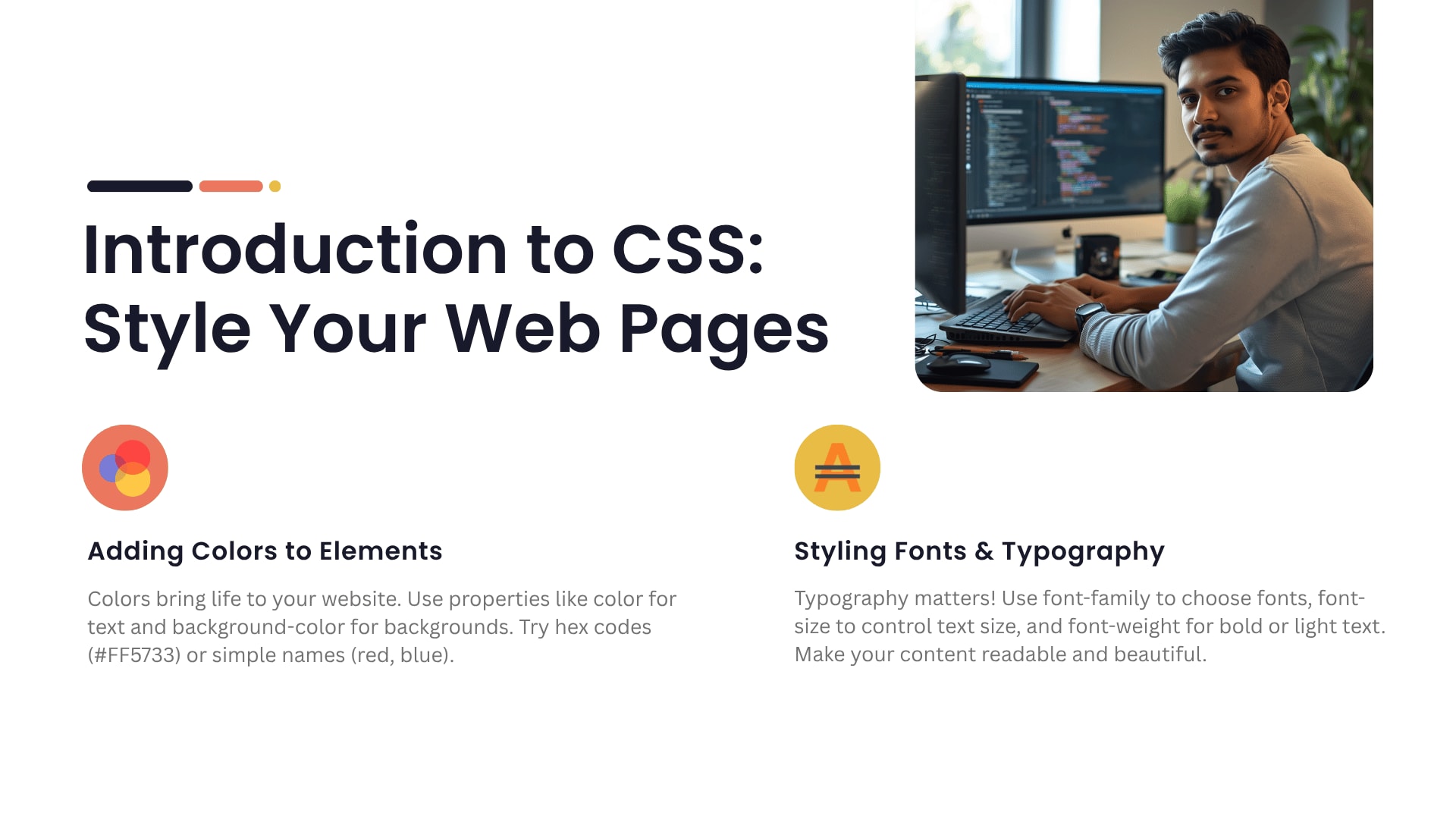
CSS is where things start to look “real,” and honestly, that’s what keeps most beginners interested. In this HTML CSS Guide for Beginners India, we keep styling approachable, not overly technical. You don’t need advanced design skills to start. Many learners trying to learn web development basics India quit before this stage because HTML alone feels boring. But once CSS comes in, things change. Even a simple HTML CSS tutorial for beginners India can make pages look surprisingly good. That motivation matters more than perfection.
Types of CSS (Inline, Internal, External)
We explain CSS types without making it sound complicated in this HTML CSS Guide for Beginners India. Inline is quick but messy, internal is okay for small projects, and external is what you’ll use most. Beginners often mix them up, especially when following random tutorials. That confusion is common in India where learning paths aren’t always structured. Once you see how they differ, it becomes much clearer. You don’t need to master all three immediately—just understand when to use what.
Basic CSS Syntax and Examples
CSS syntax looks strange at first, but it settles quickly with practice. In this HTML CSS Guide for Beginners India, we focus on writing small styles instead of memorising rules. Many beginners think they need to remember everything—that’s not how it works. You’ll naturally pick it up while building. This is why a hands-on HTML CSS course for beginners helps more than theory-heavy learning. Try changing colors, spacing, fonts—small changes teach a lot.
How HTML and CSS Work Together in Web Development
Think of HTML as structure and CSS as presentation—they depend on each other more than beginners expect. In this HTML CSS Guide for Beginners India, we show how combining both creates actual webpages, not just code files. Many learners in India understand them separately but struggle to connect them. That gap is what we try to fix. When you see your page styled properly for the first time, it just clicks. That’s when learning feels real.
Linking CSS to HTML Step-by-Step
Linking CSS is one of those small steps that confuses beginners more than it should. In this HTML CSS Guide for Beginners India, we walk through it slowly. One wrong file path and nothing works—which frustrates a lot of learners. This is where many people quit thinking they did something “wrong.” It’s normal. Once you get it right once, it sticks. That’s why practice matters more than reading.
How to Learn HTML CSS Guide for Beginners India (Step-by-Step Roadmap)
Learning randomly rarely works, especially when you’re just starting. In this HTML CSS Guide for Beginners India, we follow a simple roadmap so you don’t feel lost halfway. Many learners in India try multiple courses but still feel unsure because there’s no structure. We suggest going step-by-step, even if it feels slow. That’s how you actually learn web development basics India properly. A clear path saves time, even if it doesn’t feel fast at first.
Step 1: Start with HTML Basics
We always start with HTML, even if you’re eager to jump into styling. In this HTML CSS Guide for Beginners India, we keep the focus on understanding structure first. Many beginners skip this and struggle later. It’s not about speed—it’s about clarity. Once HTML feels comfortable, everything else becomes easier.
Beginner Exercises for HTML Practice
Simple exercises work better than complex projects in the beginning. In this HTML CSS Guide for Beginners India, we suggest building small pages—about you, a simple blog, anything basic. Many learners in India don’t practice enough, which slows progress. Even 20 minutes of daily practice helps more than long sessions once a week.
Step 2: Learn CSS for Styling Websites
Once HTML is clear, CSS becomes easier to pick up. In this HTML CSS Guide for Beginners India, we focus on practical styling, not just theory. Many beginners enjoy this stage more because results are visible. It keeps you motivated, which is important when learning alone.
Colors, Fonts, and Layout Basics
We keep design basics simple in this HTML CSS Guide for Beginners India. You don’t need to be a designer to make clean pages. Focus on readable fonts, simple colors, and basic layouts. That’s enough to start. Over time, your sense of design improves naturally.
Step 3: Practice with Real Projects
This is where most learners either improve or get stuck. In this HTML CSS Guide for Beginners India, we strongly push real projects early. Watching tutorials alone won’t build confidence. Many learners in India realise this late. Even small projects make a big difference.
Build Your First Portfolio Website
Your first portfolio won’t be perfect—and that’s fine. In this HTML CSS Guide for Beginners India, we encourage building it anyway. It helps you see progress clearly. Plus, it becomes useful when applying for internships or freelance work later.
Best Resources to Learn HTML CSS in India
There’s no shortage of resources, but too many options can slow you down. In this HTML CSS Guide for Beginners India, we suggest sticking to a few reliable ones. Many beginners in India keep switching platforms, which resets progress. Consistency matters more than the “best” course.
Free vs Paid Courses Comparison
Free content is great to start, but it often lacks structure. In this HTML CSS Guide for Beginners India, we’ve seen learners benefit from some paid options too. It depends on how you learn best. Paid doesn’t always mean better—but structured usually helps.
Recommended HTML CSS Course for Beginners
If you prefer guided learning, a structured HTML CSS course for beginners can help avoid confusion. In this HTML CSS Guide for Beginners India, we often mention practical programs like JioSkill’s one-month internship. It’s not about hype—it just gives a clear path and some real experience, which many beginners need.
Career Opportunities After Learning HTML CSS in India
Once you’re comfortable with basics, opportunities do start opening up. In this HTML CSS Guide for Beginners India, we keep expectations realistic. HTML and CSS alone won’t land high-paying roles, but they’re the starting point. Many beginners in India enter internships first, then grow from there.
Top Web Development Jobs for Beginners in India
Common roles include frontend intern, junior web developer, or website assistant. In this HTML CSS Guide for Beginners India, we suggest aiming for entry-level roles first. That’s how most careers begin here. Experience matters more than theory.
Salary Expectations for Freshers
Freshers usually start modestly, especially in India. In this HTML CSS Guide for Beginners India, we’ve seen salaries vary widely depending on skills and projects. It’s not always high at the start—but it improves with experience.
Freelancing and Internship Opportunities
Freelancing is possible, but not always easy at the beginning. In this HTML CSS Guide for Beginners India, we recommend combining it with internships. That balance helps you learn faster and earn a bit on the side.
How to Start Freelancing as a Beginner
Start small—basic websites, simple fixes. In this HTML CSS Guide for Beginners India, we suggest focusing on learning, not just earning. Many beginners in India expect quick results here and get discouraged. It takes time.
One-Month Online Internship on JioSkill (jioskill.com)
For those who prefer structured experience, JioSkill’s one-month internship is a practical option. In this HTML CSS Guide for Beginners India, we mention it because it offers guided tasks and some real exposure. It’s not a shortcut, but it does help build confidence step by step.
Next Steps After HTML CSS
Once you’re comfortable, the next step becomes clearer. In this HTML CSS Guide for Beginners India, we usually guide learners toward JavaScript. That’s where interactivity begins.
Learn JavaScript and Frontend Frameworks
After finishing this HTML CSS Guide for Beginners India, moving to JavaScript makes sense. Frameworks can come later. Many learners in India rush into them too early and feel stuck. Build your base first—it pays off.
JioSkill Team
Content Creator
Content creator at JioSkill