
Starting college is exciting, but it also brings new responsibilities, unfamiliar subjects, and higher expectations. A BCA/B.Tech First-Year Handbook helps students understand what to expect during the first year, how to perform well academically, which technical and soft skills to build, and how early preparation can improve internship and placement opportunities. Students who create good study habits and begin developing industry-relevant skills from the first semester usually find it easier to succeed throughout their degree.
Many first-year students believe placements are something to think about in the final year. In reality, companies often look for candidates who have built a strong foundation over several semesters. Academic performance, coding ability, communication skills, teamwork, projects, internships, and consistent learning all contribute to employability.
Whether pursuing a Bachelor of Computer Applications (BCA) or a Bachelor of Technology (B.Tech), the first year is the ideal time to develop the right mindset. Instead of focusing only on examinations, students should balance classroom learning with practical experience. This approach not only improves confidence but also prepares them for changing industry requirements.
This BCA/B.Tech First-Year Handbook explains the academic journey, practical skill development, placement preparation, project ideas, internship planning, and career-building strategies in a clear and beginner-friendly way.
Why the First Year Matters More Than Most Students Realize
A successful BCA/B.Tech First-Year Handbook begins with one important truth: the first year shapes future academic performance, technical confidence, and placement readiness. Students who establish consistent learning habits early generally find advanced subjects easier, build stronger portfolios, and experience less stress during internships and campus recruitment.
The transition from school to college often surprises new students. Classes become more independent, professors expect self-learning, and assignments require deeper understanding rather than memorization.
Many students initially struggle because they continue using school study methods. College education, especially in technical programs, rewards curiosity, practical application, and continuous improvement.
Common First-Year Challenges
Students across engineering and computer application programs frequently experience similar obstacles:
Understanding unfamiliar technical concepts
Managing multiple subjects simultaneously
Adjusting to semester examinations
Learning programming for the first time
Speaking confidently during presentations
Finding reliable study resources
Maintaining motivation throughout the semester
These challenges are completely normal. The difference lies in how students respond to them.
A Typical First-Year Experience
A student entering BCA without prior coding knowledge may initially feel overwhelmed by programming classes. After spending just one hour every day practicing small coding exercises, participating in lab sessions, and asking questions during lectures, the same student often becomes comfortable writing programs within a few months.
Small daily improvements usually outperform occasional intensive study sessions.
Benefits of Taking the First Year Seriously
Students who remain consistent during the first year often gain several long-term advantages:
Better academic performance
Strong programming fundamentals
Improved confidence
Easier understanding of advanced subjects
Better internship opportunities
Stronger placement preparation
Professional communication skills
Reduced academic pressure in later years
Understanding the First-Year Curriculum
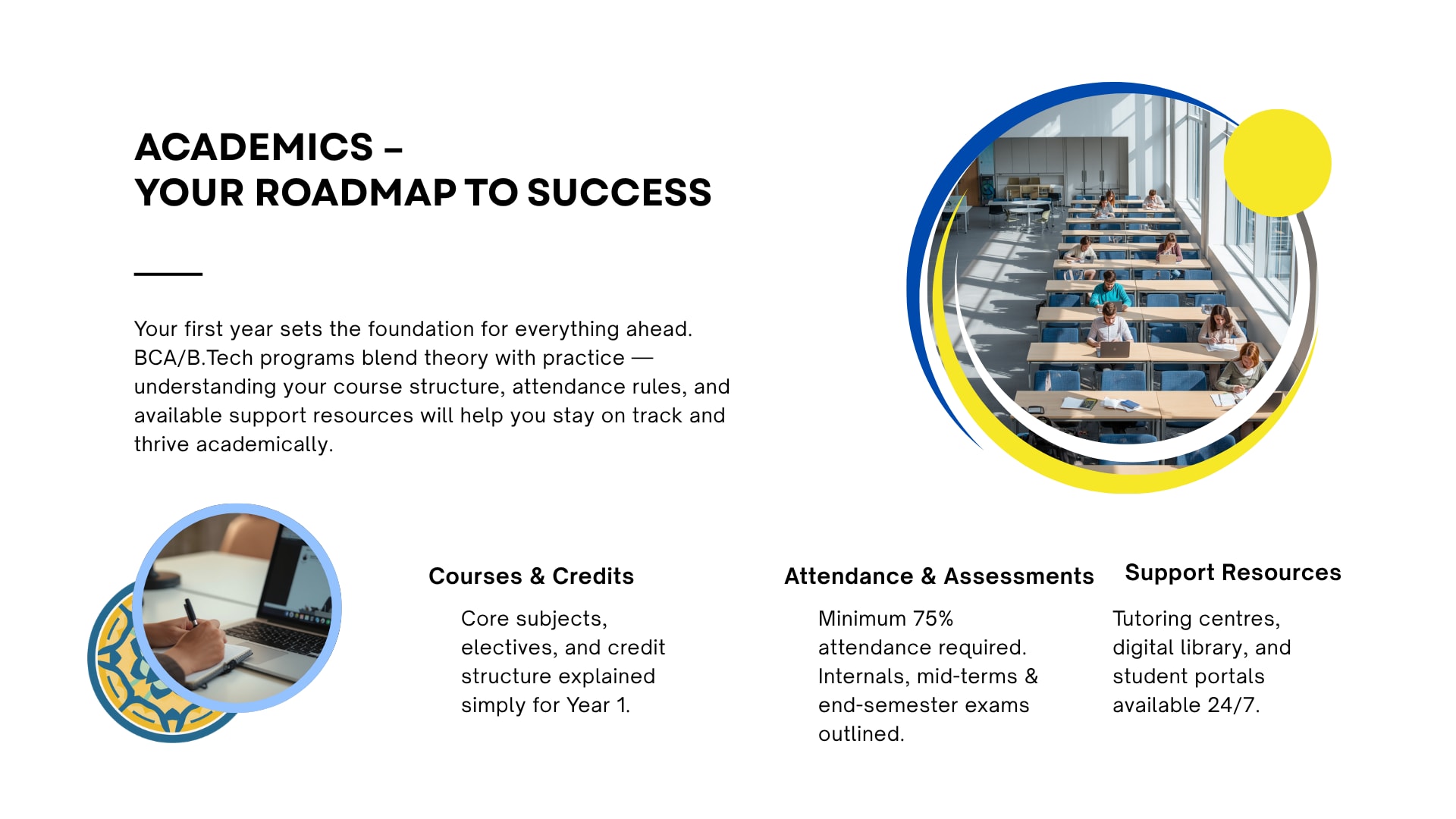
A BCA/B.Tech First-Year Handbook should clearly explain that first-year subjects are designed to build the foundation for every advanced technical topic students will study later. Although BCA and B.Tech programs differ, both introduce analytical thinking, programming basics, mathematics, communication, and problem-solving skills essential for long-term career growth.
Many students expect to start building advanced software immediately. Instead, colleges focus on strengthening the fundamentals because these concepts support every future specialization.
One Comparison: BCA vs B.Tech First-Year Curriculum
AreaBCA First YearB.Tech First YearProgrammingC, Python, Programming BasicsC, Python or C++, Programming FundamentalsMathematicsDiscrete Mathematics, Basic MathematicsEngineering MathematicsComputer FundamentalsComputer Organization, Operating Systems BasicsEngineering Computing ConceptsPractical LabsProgramming Lab, Computer LabProgramming Lab, Engineering WorkshopCommunicationEnglish CommunicationProfessional CommunicationAdditional SubjectsDatabase Basics, Office ApplicationsPhysics, Chemistry, Engineering Graphics
Although course names differ among universities, the objective remains similar: building a strong technical foundation.
Core Subjects Every Student Should Master
A BCA/B.Tech First-Year Handbook emphasizes that mastering core subjects is more valuable than simply passing examinations. Students who understand programming, mathematics, communication, and logical reasoning during the first year usually perform better in advanced technical subjects and placement interviews.
Instead of memorizing answers, students should focus on understanding how concepts work in real situations.
Programming Fundamentals
Programming is usually the biggest adjustment for first-year students.
Common topics include:
Variables
Data types
Operators
Conditional statements
Loops
Functions
Arrays
Basic file handling
Rather than copying code from classmates, students benefit more by writing every program independently.
Even simple exercises help strengthen logical thinking.
Examples include:
Number guessing game
Calculator
Student marks management
Pattern printing
Simple banking simulation
Regular coding practice gradually improves confidence.
Mathematics
Many students underestimate mathematics because they associate it only with examinations.
In reality, mathematics supports:
Algorithms
Artificial Intelligence
Data Science
Machine Learning
Cybersecurity
Software Engineering
Understanding concepts is more beneficial than memorizing formulas.
Communication Skills
Technical knowledge alone rarely guarantees placement success.
Students should practice:
Speaking confidently
Writing emails
Delivering presentations
Participating in discussions
Explaining technical ideas clearly
Communication improves naturally through regular participation rather than waiting until placement season.
Computer Fundamentals
Students also learn:
Computer architecture
Memory
Input-output devices
Operating systems
Networking basics
Internet technologies
These concepts later become essential during interviews.
Building Effective Study Habits During the First Semester
A BCA/B.Tech First-Year Handbook recommends creating consistent study routines instead of relying on last-minute preparation. Students who review concepts every week, complete practical exercises, and revise regularly usually achieve stronger academic performance while reducing examination stress.
Many high-performing students are not necessarily studying longer hours—they are studying more consistently.
A Practical Weekly Study Plan
An effective routine might include:
Attend every lecture actively.
Revise class notes within 24 hours.
Practice coding for at least one hour.
Solve mathematics problems regularly.
Complete lab assignments independently.
Spend time reading technical articles.
Revise weekly before starting new topics.
Following a structured schedule prevents knowledge gaps from growing over time.
Organizing Notes
Instead of maintaining one notebook for everything, students can separate notes into categories:
Classroom notes
Programming concepts
Mathematics formulas
Interview preparation
Mini project ideas
This organization saves significant revision time before examinations.
Learning Beyond the Classroom
Professors introduce concepts, but deeper understanding often comes through additional practice.
Students should:
Solve coding exercises
Watch concept demonstrations
Build small applications
Participate in discussions
Read official documentation
Independent learning becomes increasingly valuable throughout college.
Academic Success Is About Understanding, Not Memorization
A BCA/B.Tech First-Year Handbook highlights that technical education rewards conceptual understanding more than memorized answers. Students who actively solve problems, ask questions, and apply classroom concepts in practical scenarios develop stronger analytical skills and perform better in examinations as well as interviews.
For example, memorizing a sorting algorithm may help in an examination.
Implementing that algorithm, analyzing its efficiency, and understanding where it should be used prepares students for technical interviews.
Practical Ways to Improve Understanding
Students can strengthen concepts by:
Teaching classmates
Writing code without referring to notes
Explaining topics aloud
Creating diagrams
Solving previous-year question papers
Experimenting with different coding approaches
Each activity improves long-term retention.
Learning From Mistakes
Every student encounters bugs, incorrect outputs, and failed assignments.
Rather than becoming discouraged, successful students use mistakes as learning opportunities.
Professional software developers spend considerable time debugging. Developing patience during the first year builds valuable industry habits.
Developing Technical Skills Alongside Academics
A BCA/B.Tech First-Year Handbook encourages students to build technical skills alongside classroom learning because employers value practical abilities as much as academic knowledge. Learning industry tools, practicing coding regularly, and working on small projects during the first year creates a stronger foundation for internships and placements.
Many companies assess what students can build—not just what they have studied.
Technical Skills Worth Learning Early
Students should gradually become familiar with:
Programming fundamentals
Git and GitHub
HTML
CSS
Basic JavaScript
Database fundamentals
SQL
Linux basics
Basic computer networking
Learning these gradually is far more effective than trying to master everything in one semester.
Why GitHub Matters
Maintaining coding projects on GitHub demonstrates consistent learning and practical experience.
Students can also explore beginner-friendly repositories and collaborative coding practices through GitHub:
https://github.com/
Even small projects uploaded regularly help create a professional portfolio over time.
Coding Practice Should Become a Daily Habit
Daily coding develops:
Logical thinking
Debugging ability
Pattern recognition
Problem-solving confidence
Programming speed
Even 30–60 minutes of focused coding every day often produces better results than long weekend study sessions.
Building Soft Skills That Support Long-Term Career Growth
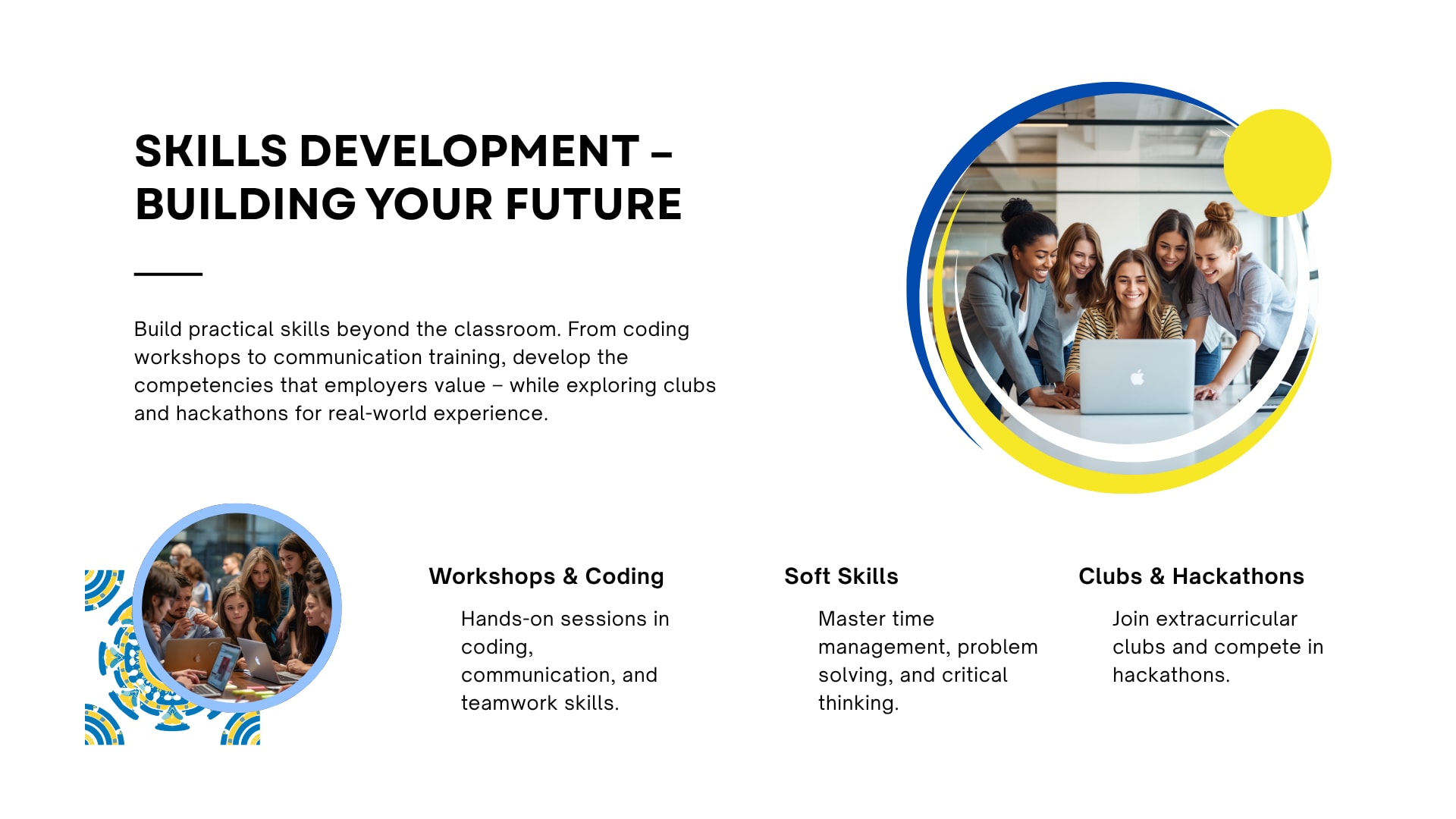
A BCA/B.Tech First-Year Handbook should highlight that technical knowledge alone is rarely enough for academic success or campus placements. Students who begin developing communication, teamwork, leadership, adaptability, and problem-solving skills during the first year often perform better in interviews, internships, hackathons, and collaborative projects.
Many recruiters mention that they can teach new technologies, but they look for candidates who can communicate ideas clearly, work with others, and learn quickly. These qualities are easier to build gradually than to develop just before placement season.
Communication Skills for Technical Students
Communication is not limited to speaking fluent English. It includes expressing ideas confidently, writing professionally, asking meaningful questions, and explaining technical concepts in a simple way.
Students can improve communication by:
Participating in classroom discussions
Giving short presentations
Reading technology blogs regularly
Writing summaries after learning new concepts
Speaking with classmates in English for a few minutes each day
Practicing interview introductions
A student who confidently explains how a simple calculator program works often leaves a stronger impression than someone who memorizes complicated definitions.
Teamwork Begins in the First Semester
Almost every software project involves collaboration.
First-year students should actively participate in:
Group assignments
Coding competitions
Technical clubs
College events
Project discussions
Open-source communities
Learning to divide tasks, manage deadlines, and resolve disagreements respectfully becomes valuable during internships and full-time jobs.
Time Management Is a Competitive Advantage
Many students struggle because they postpone assignments until the deadline.
Simple planning habits make a significant difference.
An effective weekly routine usually includes:
Reviewing lecture notes daily.
Completing assignments early.
Practicing coding consistently.
Scheduling revision before tests.
Reserving time for personal learning.
Taking regular breaks to avoid burnout.
Managing time well also creates opportunities to explore certifications, projects, and extracurricular activities.
Developing a Growth Mindset
The first semester is rarely perfect.
Students may receive lower marks than expected, struggle with programming, or find mathematics difficult. These experiences should not be viewed as failures.
Students who ask for help, practice consistently, and stay curious usually improve much faster than those who compare themselves with others.
Learning Programming the Right Way
A BCA/B.Tech First-Year Handbook recommends focusing on programming logic instead of memorizing syntax. Students who understand how to solve problems step by step generally learn new programming languages more quickly and become more confident during coding interviews.
Programming is often the biggest concern for first-year students.
Many beginners believe successful programmers write code without mistakes. In reality, experienced developers constantly debug, test, and improve their programs.
Start with Logic Before Syntax
Before writing code, students should learn to answer questions such as:
What problem needs to be solved?
What inputs are required?
What output is expected?
Which steps will solve the problem?
Can the solution be simplified?
This habit improves logical thinking regardless of the programming language.
Practice Small Coding Problems Daily
Instead of attempting complex projects immediately, beginners should solve manageable exercises.
Examples include:
Even and odd number checker
Prime number finder
Student grade calculator
Temperature converter
Simple billing system
Password validator
Number pattern generator
Each small program strengthens programming fundamentals.
Understand Errors Instead of Avoiding Them
Debugging teaches valuable lessons.
Common beginner mistakes include:
Missing semicolons
Incorrect loop conditions
Variable naming errors
Array index mistakes
Infinite loops
Incorrect input handling
Rather than copying corrected code, students should identify why the error occurred.
That process builds real programming ability.
Practice Without Looking at Solutions
Many students immediately search online when they face difficulties.
A better approach is:
Read the question carefully.
Think about possible solutions.
Write pseudocode.
Attempt coding independently.
Debug patiently.
Compare with reference solutions only after trying.
This develops stronger analytical skills over time.
Creating Small Projects During the First Year
A BCA/B.Tech First-Year Handbook encourages students to begin building simple projects from the first semester because practical work strengthens classroom learning and creates an impressive portfolio for internships and placements.
Projects do not have to be complicated.
Even simple applications demonstrate curiosity and practical understanding.
Beginner-Friendly Project Ideas
Students can build projects such as:
Student attendance system
Personal expense tracker
Digital library management
Quiz application
Calculator with GUI
Contact management system
To-do list application
Weather application using APIs
Password generator
Basic portfolio website
Completing several small projects often provides more learning than attempting one large project without understanding it.
What Recruiters Notice
Recruiters usually appreciate projects that demonstrate:
Clean code
Logical structure
Proper documentation
Real-world usefulness
Continuous improvement
A simple project built independently often creates a stronger impression than a copied advanced application.
Document Every Project
Students should maintain documentation that includes:
Project objective
Technologies used
Challenges faced
Solutions implemented
Future improvements
This preparation makes interview discussions much easier.
Exploring Emerging Technologies Without Feeling Overwhelmed
A BCA/B.Tech First-Year Handbook advises students to explore modern technologies gradually while focusing primarily on strong fundamentals. Understanding programming basics before specializing allows students to adapt more easily as technology continues to evolve.
Every year brings new technology trends.
Artificial Intelligence, Cybersecurity, Cloud Computing, Data Science, Blockchain, and DevOps receive significant attention.
First-year students often feel pressure to learn everything.
That approach usually leads to confusion.
Build a Strong Foundation First
Students should prioritize:
Programming fundamentals
Data structures (basic understanding)
Computer fundamentals
Mathematics
Logical reasoning
These subjects support every technology specialization.
Areas Worth Exploring
After becoming comfortable with fundamentals, students can gradually explore:
Artificial Intelligence
Machine Learning
Data Analytics
Cybersecurity
Cloud Computing
Mobile App Development
Web Development
UI/UX Design
Internet of Things
DevOps
Exploration should remain balanced with academic responsibilities.
Follow Reliable Learning Resources
Official documentation often provides the most accurate learning material.
Students interested in programming technologies can explore tutorials and learning paths from Microsoft Learn:
Learning from trusted resources reduces confusion and builds accurate understanding.
Participating in College Activities Beyond the Classroom
A BCA/B.Tech First-Year Handbook explains that extracurricular activities help students develop confidence, leadership, teamwork, and networking skills that complement technical education. These experiences often become valuable talking points during internship and placement interviews.
College offers much more than lectures.
Students should participate whenever possible.
Useful Activities Include
Coding competitions
Technical fests
Hackathons
Robotics clubs
Programming communities
Debate competitions
Entrepreneurship cells
Innovation challenges
Student chapters
Cultural events
These activities help students interact with peers from different backgrounds.
Why Hackathons Matter
Hackathons encourage students to:
Solve real-world problems
Build projects quickly
Collaborate effectively
Learn new technologies
Improve presentation skills
Winning is not the only objective.
Participation itself provides meaningful experience.
Building Professional Networks
Networking begins during college.
Students can connect with:
Seniors
Professors
Alumni
Guest speakers
Industry mentors
Many internship opportunities arise through professional relationships rather than traditional job applications.
Developing a Professional Online Presence
A BCA/B.Tech First-Year Handbook recommends creating a professional digital identity early because recruiters frequently review online profiles before interviews. A well-maintained portfolio reflects seriousness, consistency, and genuine interest in technology.
Students do not need years of experience to establish an online presence.
They simply need to document their learning journey.
Create a Simple Portfolio
A basic portfolio may include:
Introduction
Academic details
Skills
Projects
Certifications
Achievements
Contact information
As experience grows, the portfolio can be expanded.
Keep Learning Public
Students can share:
Project updates
Coding milestones
Competition participation
Technical articles
Learning summaries
This demonstrates continuous improvement.
Maintain Professionalism
Students should remember that future employers may review public profiles.
Maintaining respectful communication, accurate information, and original work builds credibility over time.
Balancing Academics, Skills, and Personal Well-Being
ABCA/B.Tech First-Year Handbook reminds students that sustainable success depends on balancing academics, skill development, physical health, and mental well-being. Consistent progress over several semesters is more effective than periods of intense study followed by exhaustion.
Many students experience pressure after comparing themselves with high-performing classmates.
Comparison often reduces motivation rather than improving performance.
Practical Ways to Stay Balanced
Students should:
Maintain regular sleep schedules
Exercise regularly
Take short study breaks
Avoid excessive social media
Celebrate small achievements
Ask for academic help when needed
Spend time with supportive friends
Practice consistent learning instead of cramming
Healthy routines improve concentration and productivity.
Managing Examination Stress
Examination anxiety can be reduced through preparation rather than last-minute studying.
Helpful strategies include:
Start revision early.
Solve previous question papers.
Review important formulas regularly.
Practice programming manually.
Sleep adequately before examinations.
Stay calm during tests.
Confidence grows naturally through preparation.
Preparing Early for Future Internship Opportunities
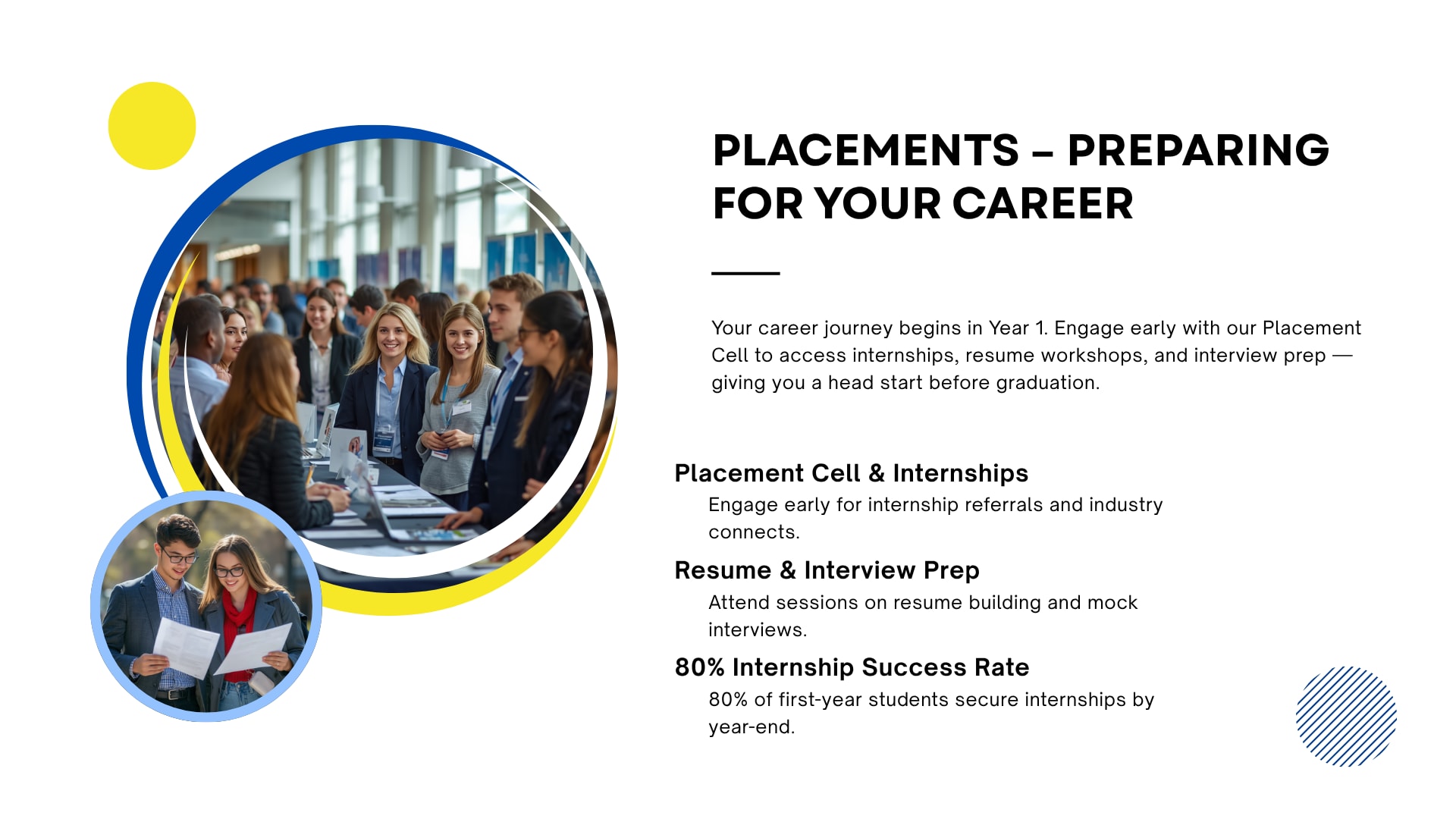
A BCA/B.Tech First-Year Handbook emphasizes that internship preparation should begin long before students become eligible to apply. Building skills, projects, communication abilities, and a learning portfolio during the first year significantly improves future internship prospects.
Many companies prefer students who demonstrate initiative rather than waiting until the final year to begin learning.
By the end of the first year, students should ideally have:
Strong programming basics
Multiple small projects
Basic GitHub profile
Improved communication skills
Fundamental problem-solving ability
Initial certifications
Active participation in college activities
These achievements create a strong foundation for future internships and placements.
JioSkill Team
Content Creator
Content creator at JioSkill