
Top IT Skills to Learn in 2026 for Beginners Starting a Tech Career
The tech industry isn’t slowing down—if anything, it’s picking up speed. Companies are expanding, new technologies are emerging, and there’s this constant, almost desperate need for skilled people. But here’s what nobody tells you: you don’t need to be some coding prodigy or have a four-year degree in computer science to break in. A lot of the most valuable, in-demand skills are surprisingly accessible if you’re willing to put in the work.
I’m going to walk you through the Top IT Skills to Learn in 2026—the ones that’ll actually help you build a career, not just pad your resume. And because we’re being practical here, many of these Top IT Skills to Learn in 2026 overlap with the high-paying IT skills 2026, which means you’re not just learning for the sake of checking boxes. You’re setting yourself up for real growth and real money.
Why This Stuff Actually Matters (And Why Now Is the Time)
Let’s zoom out for a second. Technology used to be this separate thing—like, “oh, that’s what the IT department handles.” Not anymore. Now it’s embedded in literally every industry you can think of. Hospitals need IT systems to manage patient records. Banks run on complex networks and security protocols. Schools use cloud platforms for everything from attendance to online learning. Retail stores track inventory with sophisticated databases.
What does that mean for you? It means the demand isn’t just coming from Silicon Valley tech giants. It’s coming from everywhere. Small businesses, nonprofits, government agencies, healthcare organizations—they all need people who understand how technology works and can keep things running smoothly.
And here’s the kicker: even entry-level positions in IT tend to pay better than entry-level jobs in most other fields. Plus, a ton of these roles offer remote work options, which is huge if you value flexibility or don’t live near a major tech hub. On top of that, there’s legitimate room to grow. Start in IT support, and within a few years, you could be doing cybersecurity or cloud architecture. The career ladder is real, and it’s climbable.
1. Basic Cybersecurity Skills—Your Gateway to One of the Hottest Fields
Cybersecurity keeps showing up on every “most in-demand” list, and it’s consistently one of the high-paying IT skills 2026. It’s also genuinely one of the Top IT Skills to Learn in 2026 if you want job security and growth potential. But here’s what’s great about it: you don’t have to be some elite hacker to get started. The entry-level stuff is about understanding how attacks happen, how to prevent them, and how to use the tools that keep systems safe.
Think about it—every single day, companies are dealing with phishing attempts, ransomware threats, data breaches. They need people who can spot the red flags and respond appropriately. That could be you, and you can start learning this stuff right now from your living room.
What you’ll actually learn as a beginner:
- Password security and authentication: How strong passwords work, why multi-factor authentication matters, and how companies manage access to sensitive systems. This sounds basic, but it’s the foundation of everything in security.
- Firewalls and antivirus basics: Understanding how these tools create barriers between safe and unsafe zones, and how they detect and stop threats before they cause damage.
- Recognizing phishing and social engineering: Learning to spot fake emails, suspicious links, and the psychological tricks attackers use to manipulate people. This skill alone is incredibly valuable because human error is the #1 security vulnerability.
- Network security fundamentals: Getting familiar with concepts like encryption, secure connections (HTTPS vs HTTP), and how data travels safely across networks.
Where to actually start:
- Google Cybersecurity Certificate: This is genuinely one of the best beginner-friendly programs out there. It’s affordable, it’s practical, and it’s designed for people with zero background in tech.
- CompTIA Security+: This is the next step up once you’ve got the basics down. It’s more technical and carries more weight with employers, especially if you’re aiming for roles beyond entry-level.
The beautiful thing about cybersecurity is that once you get your foot in the door, the career paths branch out in a million directions—penetration testing, security analysis, compliance, incident response. You can specialize in whatever interests you most.
2. Cloud Computing Fundamentals—Because Everything Lives in the Cloud Now
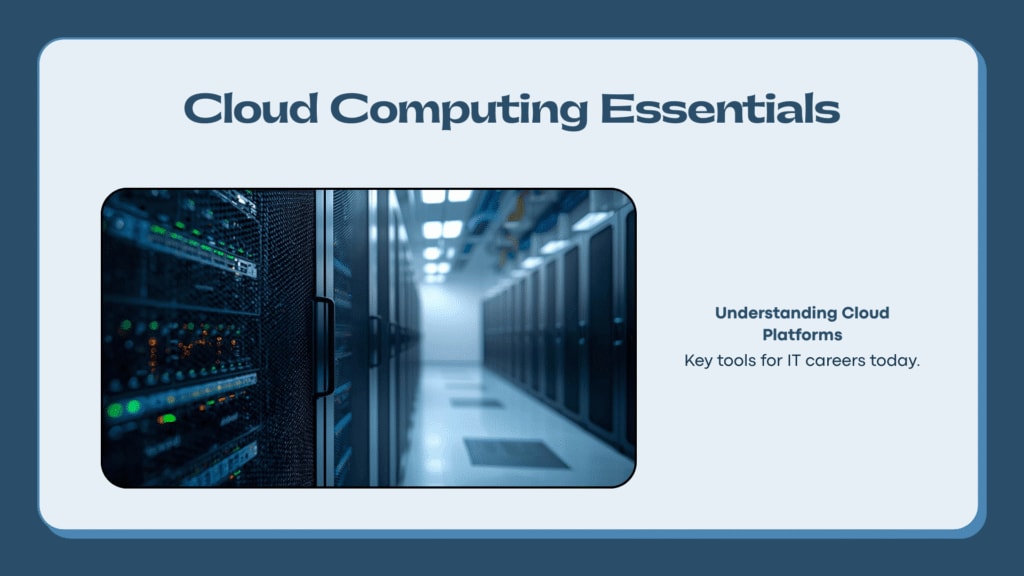
If there’s one skill that’s absolutely essential among the Top IT Skills to Learn in 2026, it’s cloud computing. Seriously, at this point, nearly every modern company relies on cloud infrastructure. Whether they’re using AWS, Microsoft Azure, or Google Cloud, the shift from physical servers to cloud-based systems is pretty much complete.
And the best part? You can start with the absolute basics and build up gradually. Nobody expects you to design complex cloud architectures on day one. You just need to understand what the cloud is, how it works, and how businesses use it. This makes cloud computing one of the most accessible Top IT Skills to Learn in 2026 for beginners.
What beginners can actually wrap their heads around:
- Understanding what “the cloud” really means: Spoiler alert—it’s not some magical floating thing. It’s just computers and servers that someone else owns and maintains, and you access them over the internet. Once you get that, everything else clicks into place.
- Cloud storage and file sharing: Learning how to use services like AWS S3 or Azure Blob Storage to store data, and understanding why companies prefer cloud storage over physical hard drives (hint: it’s scalable, accessible, and way more reliable).
- Basic cloud security practices: How to set permissions correctly, why encryption matters in the cloud, and understanding shared responsibility models (basically, what the cloud provider handles vs. what you’re responsible for).
- Simple cloud services: Getting comfortable with things like virtual machines (computers that exist in the cloud), databases (where applications store their data), and basic networking concepts in a cloud environment.
Good places to start your cloud journey:
- AWS Cloud Practitioner: Amazon Web Services is the biggest player in cloud computing, and their Cloud Practitioner certification is designed specifically for beginners. It covers the fundamentals without getting too technical.
- Microsoft Azure Fundamentals: If you’re leaning toward enterprise environments (big corporations), Azure is huge. Their fundamentals cert is similarly beginner-friendly and gives you a solid foundation.
Here’s why this matters so much: cloud skills are transferable across almost every IT role. Whether you end up in cybersecurity, data analysis, software development, or IT support, you’re going to interact with cloud systems. Learning this early gives you a massive advantage.
3. IT Support and Technical Troubleshooting—The Best Place to Start
Let’s be real for a second: IT support is where most people actually begin their tech careers, and it’s legitimately one of the Top IT Skills to Learn in 2026 for good reason. It teaches you how everything works at a fundamental level—how computers operate, how networks connect, how software behaves, and how to solve problems when things inevitably break.
It’s also one of the easiest paths to get hired quickly. Companies always need IT support people, and the barrier to entry is lower than almost any other tech role. Plus, it’s genuinely great preparation for whatever you want to do next. Want to move into cybersecurity? IT support teaches you the systems you’ll be protecting. Interested in cloud computing? You’ll learn how infrastructure works from the ground up.
What you’ll actually pick up:
- How operating systems function: Getting comfortable with Windows, macOS, and Linux. Understanding how they manage files, run programs, and handle user accounts. This is the foundation of everything else.
- Basic hardware setup and troubleshooting: Learning what’s inside a computer, how components connect, and how to diagnose hardware problems. Can you tell if a slow computer needs more RAM or if it’s a hard drive issue? That’s the kind of practical knowledge you’ll gain.
- Fixing common software issues: Application crashes, installation problems, software conflicts—you’ll learn how to troubleshoot these systematically instead of just randomly clicking around hoping something works.
- User support and communication: Helping people with password resets, access issues, and general tech questions. This teaches you something crucial that doesn’t get talked about enough: how to explain technical things to non-technical people. That’s a skill that’ll serve you your entire career.
Beginner-friendly certifications that actually matter:
- Google IT Support Certificate: This program is fantastic. It covers everything from hardware and networking basics to security and troubleshooting. It’s self-paced, affordable, and you can complete it in a few months if you’re dedicated.
- CompTIA A+: This is the industry standard certification for IT support. It’s more comprehensive than the Google cert and carries a lot of weight with employers. If you’re serious about IT support as a career path, this one’s worth getting.
One more thing: don’t underestimate IT support as “just a starting point.” Some people build entire careers here, moving into roles like IT manager, systems administrator, or technical project manager. It’s a legitimate path, not just a stepping stone.
4. Networking Basics—The Invisible Infrastructure That Connects Everything
Here’s something most people don’t think about: every single thing you do online—every website you visit, every email you send, every video you stream—depends on networking. It’s the invisible infrastructure that makes all of technology possible. And understanding even the basics of how networks work is definitely among the Top IT Skills to Learn in 2026 because it opens up a ton of career opportunities.
Networking is also one of those foundational skills that makes everything else make more sense. Want to understand cloud computing better? You need to know networking. Interested in cybersecurity? Network security is a huge part of that. Even if you’re going into data analytics or programming, understanding how data moves across networks is incredibly useful.
Key concepts for beginners:
- What a network actually is: At its simplest, it’s just computers and devices talking to each other. But understanding how they talk—the rules they follow, the paths data takes—that’s where it gets interesting.
- IP addresses and DNS: Think of IP addresses like phone numbers for computers, and DNS like a phonebook that translates website names into those numbers. Understanding this helps you grasp how the internet actually functions.
- Routers, switches, and network devices: Learning what these devices do and how they direct traffic. A router connects different networks (like your home network to the internet), while a switch connects devices within the same network.
- How the internet works: This sounds broad, but getting a basic understanding of how data travels from your computer, through your ISP, across undersea cables, and to servers halfway around the world is genuinely fascinating. Plus, it helps you troubleshoot problems and understand security vulnerabilities.
Where to start:
- CompTIA Network+: This is the gold standard for networking fundamentals. It covers everything from basic concepts to more advanced topics like network security and troubleshooting. It’s challenging but absolutely worth it if you’re serious about understanding networks.
And here’s the thing: networking knowledge directly feeds into some of the high-paying IT skills 2026, like network engineering, cloud networking, and network security specialist roles. These positions often pay six figures, especially once you gain some experience.
5. Data Analytics Fundamentals—Making Sense of All That Information

Every company—and I mean every single one—is collecting data. Customer behavior, sales trends, website traffic, inventory levels, you name it. But data by itself is useless. It’s just a bunch of numbers sitting in a spreadsheet or database. What companies actually need are people who can look at that data, find patterns, and turn it into actionable insights. That’s why data analytics is firmly among the Top IT Skills to Learn in 2026.
And here’s the good news: you don’t need advanced math skills or a statistics degree to get started. Basic data analytics is more about logic, curiosity, and learning the right tools. If you can work with spreadsheets and think critically about what numbers are telling you, you can learn this.
What beginners actually learn:
- Data cleaning and organization: This is where you spend most of your time, honestly. Real-world data is messy—full of errors, duplicates, and inconsistencies. Learning how to clean it up and organize it properly is a fundamental skill that every data analyst needs.
- Using Excel or Google Sheets effectively: Most people think they know Excel, but there’s a huge difference between basic use and actually leveraging its power. You’ll learn formulas, pivot tables, conditional formatting, and other features that let you analyze data quickly.
- Creating charts and visualizations: Numbers in a spreadsheet don’t mean much to most people. But turn those numbers into a clear chart or graph, and suddenly the story becomes obvious. You’ll learn how to choose the right visualization for different types of data.
- Getting started with SQL: SQL (Structured Query Language) is how you talk to databases. It lets you pull specific data, combine information from different tables, and perform calculations. It sounds intimidating, but basic SQL is actually pretty intuitive—you’re essentially asking the database questions in a structured way.
Popular tools to focus on:
- Excel: Still the most widely used tool for data analysis, especially in smaller companies and non-tech businesses.
- SQL: Essential if you want to work with databases directly. Almost every data analyst job listing mentions SQL.
- Power BI or Google Looker Studio: These are data visualization tools that let you create interactive dashboards and reports. They’re user-friendly and look impressive when you’re presenting findings.
The career path for data analytics is solid, too. You can start as a data analyst, then move into business intelligence, data engineering, or even data science if you want to go deeper into the technical side. It’s one of those Top IT Skills to Learn in 2026 that gives you options.
6. Introductory Programming Skills—You Don’t Have to Become a Developer
Here’s the thing about programming: you don’t need to become a full-time software developer to benefit from knowing some code. Even basic programming skills make you way more valuable in almost any IT role. You can automate repetitive tasks, create simple tools, understand how software works, and communicate better with developers. That’s why programming makes the list of Top IT Skills to Learn in 2026, even for people who don’t want to be professional coders.
Plus, learning to code teaches you how to think logically and break down complex problems into manageable steps. That mindset is useful everywhere in tech.
Best programming languages for beginners:
- Python: If you only learn one language, make it Python. It’s readable, versatile, and used everywhere—web development, data analysis, automation, cybersecurity, AI, you name it. The syntax is clean and intuitive, which makes it perfect for beginners who are still learning how to think like a programmer.
- JavaScript: If you’re at all interested in web development or anything that runs in a browser, JavaScript is essential. It’s also great for automation and creating interactive tools. The learning curve is slightly steeper than Python, but it’s incredibly practical.
What you can actually build as a beginner:
- Simple automation scripts: Got a repetitive task you do every day? Write a Python script to do it for you. Rename a hundred files, scrape data from websites, send automated emails—the possibilities are endless.
- Small websites or web pages: Learn HTML, CSS, and basic JavaScript, and you can build functional websites. Even if web development isn’t your end goal, understanding how websites work is valuable in tons of roles.
- Basic tools and utilities: Need a calculator for something specific? A tool to convert file formats? A simple game? You can build these things with just a few weeks of programming knowledge.
The key here is to start small and build things that actually interest you. Don’t just follow tutorials blindly—use what you’re learning to create something you care about. That’s how it sticks.
7. AI and Automation Basics—The Skills That’ll Set You Apart
Let’s talk about AI for a minute, because it’s rapidly becoming one of the most relevant Top IT Skills to Learn in 2026. It’s not just hype anymore—it’s genuinely transforming how work gets done. Companies are using AI for customer service, data analysis, content creation, process automation, and a million other things. And while you don’t need to understand the deep technical details of machine learning algorithms, having a basic grasp of how AI works and how to use AI tools is becoming increasingly valuable.
The same goes for automation in general. If you can look at a process and say, “hey, we could automate this,” and then actually set it up, you become incredibly valuable to employers.
What beginners should focus on:
- Understanding what AI actually is (and what it isn’t): There’s a lot of confusion and hype around AI. Learning the basics—what machine learning means, how AI systems are trained, what they’re good at and what their limitations are—helps you cut through the noise and use these tools effectively.
- Using AI tools for practical tasks: Tools like ChatGPT, AI image generators, AI-powered data analysis platforms—learning how to use these effectively can dramatically increase your productivity. Knowing how to write good prompts and get useful outputs is a skill in itself.
- Basic machine learning concepts: You don’t need to build your own neural networks, but understanding concepts like training data, models, and predictions helps you work with data scientists and understand how AI-powered features work.
- Automation platforms: Tools like Zapier, Make (formerly Integromat), and Power Automate let you connect different apps and automate workflows without writing code. These are incredibly practical and can save businesses huge amounts of time.
This stuff connects directly to many of the high-paying IT skills 2026, especially roles like automation engineer, AI implementation specialist, and data analyst positions that involve working with machine learning models.
How Do You Actually Choose Among These Top IT Skills to Learn in 2026?

Look, I get it. You’re looking at this list of Top IT Skills to Learn in 2026 and feeling a little overwhelmed. That’s normal. You can’t learn everything simultaneously, and you shouldn’t try. The key is picking one thing that resonates with you and diving in. Once you get decent at that, the next skill becomes easier to learn because you’ve built up your foundational knowledge and confidence.
Here’s how I’d think about it:
Do you like solving problems and figuring out why things broke? IT support or cybersecurity might be your thing. These roles are all about troubleshooting, thinking critically, and finding solutions. If you’re the person your friends call when their computer acts weird, this could be a natural fit.
Do you enjoy working with data and spotting patterns? Data analytics is calling your name. If you like organizing information, making sense of numbers, and presenting insights clearly, this path could be really satisfying.
Do you want long-term stability and a clear career progression? Networking or cloud computing are solid bets. These are foundational skills that aren’t going anywhere, and they lead to well-paid, in-demand roles. The job market for these skills is consistently strong.
Is remote work flexibility important to you? Cloud computing, cybersecurity, and data analytics are all highly remote-friendly. Many companies are happy to hire for these roles without requiring you to be in the office.
Are you creative and like building things? Programming might click for you. If you enjoy creating something from nothing and seeing your ideas come to life, coding can be incredibly rewarding.
The honest truth is that you can’t make a wrong choice here. All of these Top IT Skills to Learn in 2026 are valuable, all of them lead somewhere, and all of them can be learned without spending four years and six figures on a traditional degree. Pick something, commit to it for a few months, and see how it feels. You can always adjust course later.
Your Actual Game Plan for Mastering the Top IT Skills to Learn in 2026
Okay, so you’ve picked a skill from the Top IT Skills to Learn in 2026. Now what? Here’s a realistic approach that actually works:
Start with free resources first. Before you spend money on courses or certifications, explore the free stuff. YouTube tutorials, free courses on platforms like Coursera and edX, documentation, practice labs—there’s a ton of high-quality content out there for free. Use this to figure out if the skill genuinely interests you.
Then invest in a structured program. Once you’re sure you want to pursue something, get a proper course or certification. The Google certificates are great. CompTIA certs are solid. Platform-specific certifications like AWS or Azure are valuable. Having that structure keeps you on track and gives you a clear goal.
Practice constantly, not just when you’re “studying.” Set up a home lab. Break things and fix them. Build projects. The hands-on experience is where real learning happens, not just watching videos or reading documentation.
Join communities focused on the Top IT Skills to Learn in 2026. Find Discord servers, Reddit communities, or local meetup groups focused on your skill. Ask questions, help others when you can, and learn from people who are a few steps ahead of you. This stuff can feel isolating if you’re learning alone.
Document what you’re learning. Start a blog, make GitHub repositories if you’re coding, or just keep detailed notes. This helps you retain information, and it also builds your portfolio. When you start job hunting, you’ll have proof of what you know.
Be patient with yourself. Learning any of the Top IT Skills to Learn in 2026 takes time, and it’s frustrating sometimes. You’ll hit walls where nothing makes sense. That’s normal. Everyone goes through it. The people who succeed aren’t necessarily smarter—they’re just the ones who didn’t quit when it got hard.
Why the Top IT Skills to Learn in 2026 Are Your Best Bet Right Now
Here’s what makes the Top IT Skills to Learn in 2026 different from tech trends in previous years: these aren’t just fleeting buzzwords. Cybersecurity, cloud computing, networking, data analytics, programming, IT support, and AI—these are foundational technologies that underpin how modern businesses operate. They’re not going anywhere.
When you invest time in the Top IT Skills to Learn in 2026, you’re not gambling on a trend that might fade in a year or two. You’re building expertise in areas that will remain relevant for the foreseeable future. Sure, specific tools and platforms will evolve, but the underlying principles stay consistent. Learn AWS today, and even if the interface changes, your knowledge transfers. Understand networking fundamentals now, and that knowledge applies whether you’re working with traditional networks or cutting-edge cloud architectures.
This is also the first time we’ve seen such a clear convergence of accessibility and opportunity. The barriers to entry have never been lower—you can learn most of these skills from home, often for free or relatively cheaply. Meanwhile, demand has never been higher. Companies desperately need skilled people, and many are willing to hire based on demonstrated skills rather than requiring traditional degrees.
Real Talk: What to Expect When Learning These Skills
Let me be honest with you about what the journey of mastering the Top IT Skills to Learn in 2026 actually looks like, because I think a lot of guides sugarcoat this part.
The first few weeks will feel overwhelming. Everything is new terminology, unfamiliar concepts, and you’ll probably feel like you’re in over your head. That’s completely normal. Push through it. After about a month of consistent practice, things start clicking into place.
You’ll have impostor syndrome. Even after you’ve learned a fair bit, you’ll sometimes feel like you don’t really know anything. You’ll see job postings with long lists of requirements and think you’re not qualified. Here’s the secret: almost everyone feels this way, even experienced professionals. The key is to apply anyway and let employers decide if you’re a fit.
Progress isn’t linear. Some days you’ll feel like you’re learning tons and making great progress. Other days, you’ll bang your head against a problem for hours and feel like you’re going backward. Both are normal parts of the process.
You might pick the “wrong” skill first. Maybe you start with data analytics and realize three months in that you actually find programming more interesting. That’s okay. The time wasn’t wasted—you learned transferable skills and you learned something about yourself. Pivot and keep going.
The tech community can be intimidating but also incredibly helpful. You’ll encounter some gatekeepers who make you feel dumb for asking basic questions. Ignore them. You’ll also find mentors, study buddies, and supportive communities that want to help you succeed. Seek out the latter.
Final Thoughts—The Top IT Skills to Learn in 2026 Can Change Your Life
The Top IT Skills to Learn in 2026 aren’t just trendy buzzwords or things that sound good on paper. They’re practical, learnable skills that lead to real jobs with real salaries. Skills like cybersecurity, cloud computing, networking, and data analytics are part of the high-paying IT skills 2026, which means you can start from zero and work your way into roles that pay well and offer genuine career growth.
But here’s what matters most: you have to actually start. Not tomorrow, not next month when you have “more time,” but now. Pick one skill from the Top IT Skills to Learn in 2026—the one that made you think, “yeah, that sounds interesting.” Find a free resource or course. Spend an hour on it today. Then do it again tomorrow.
2026 could legitimately be the year you break into tech. Not because it’s easy—it’s not—but because if you’re willing to put in consistent effort, the path is clearer now than it’s ever been. The resources exist, the demand is there, and the barriers to entry are lower than most people realize.
The Top IT Skills to Learn in 2026 represent more than just a career change—they represent opportunity, flexibility, financial security, and intellectual growth. They represent the chance to build something meaningful in an industry that’s shaping our future. Top IT Skills to Learn in 2026 for Beginners Starting a Tech Career .
JioSkill Team
Content Creator
Content creator at JioSkill